
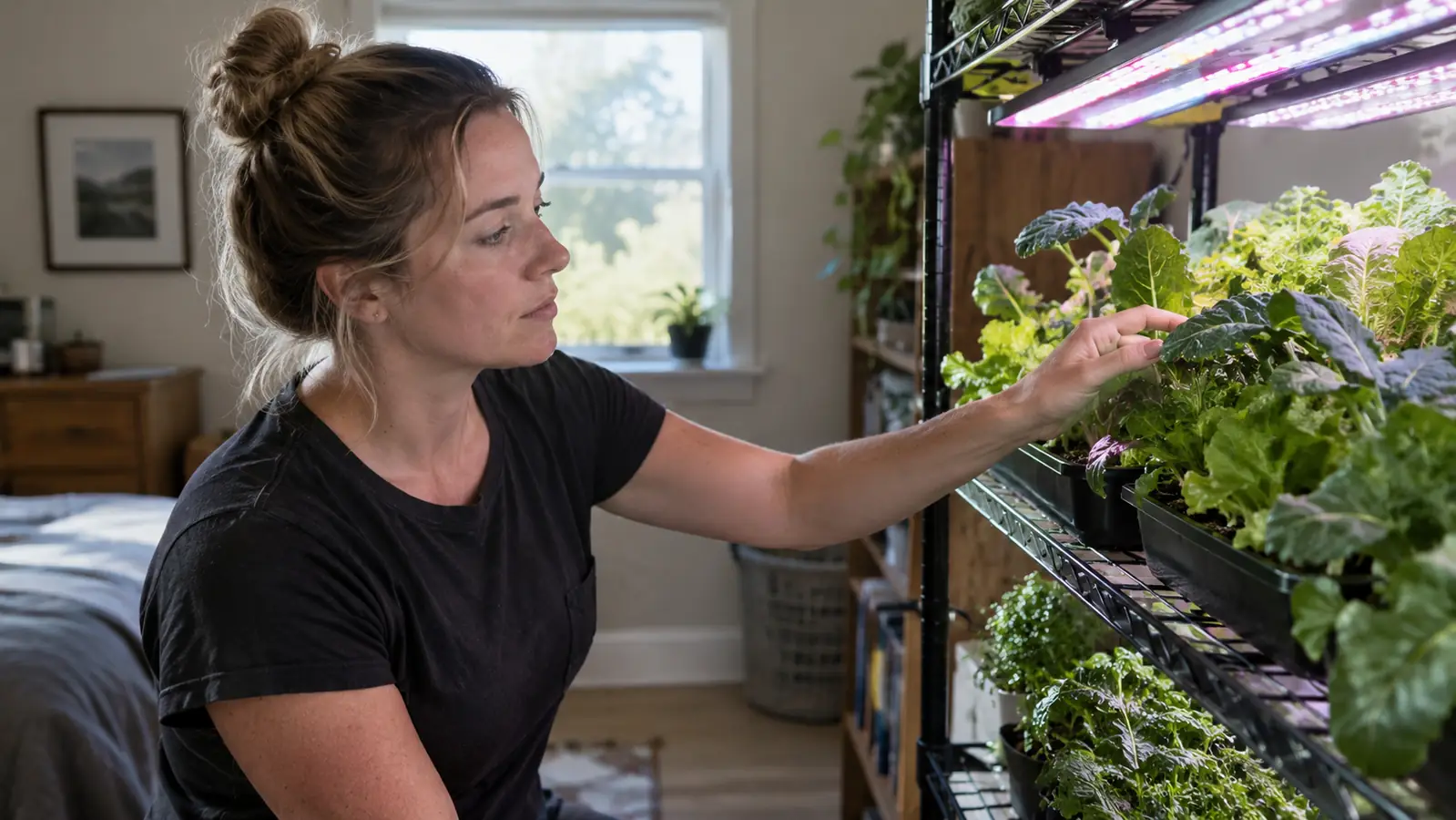
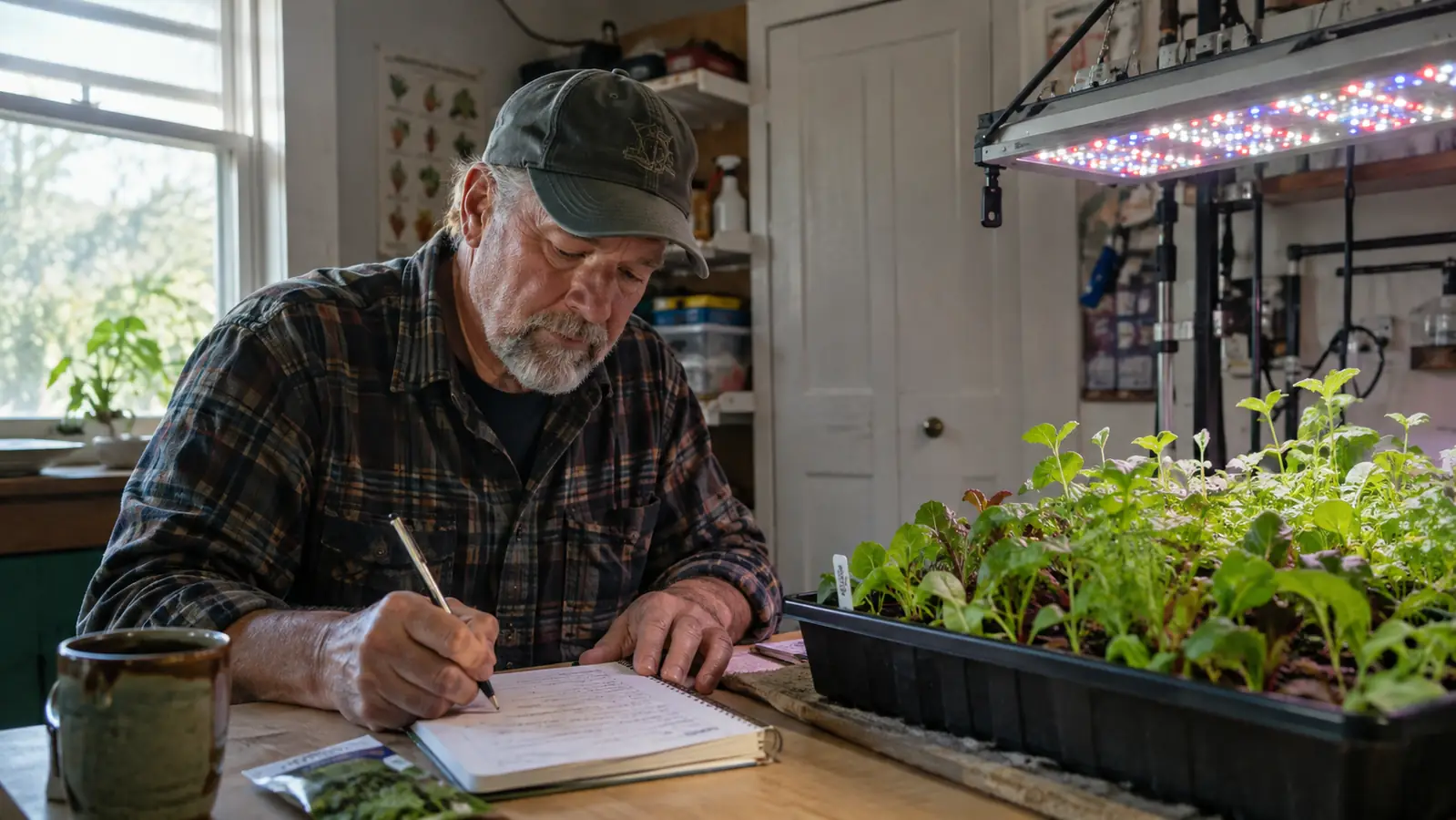
I started growing indoors about four years ago, after my back made bending over raised beds a losing game. My wife Linda wanted basil and lettuce in January, and I wanted a project I could measure. So I cleared out a spare bedroom upstairs, hung a MARS HYDRO TS1000 over a shelving unit, and started keeping a paper grow log like I used to keep service records. The first batch of lettuce I tried under an old fluorescent shop light came up pale and leggy, and that failure is what pushed me toward a full spectrum LED in the first place. This list is the short version of what that notebook has taught me.
One light that does the whole job, start to finish
The MARS HYDRO TS1000 covers seedlings, leafy greens, and herbs under a single full spectrum LED. No swapping bulbs, no second fixture for flowering. Check today's price on Amazon and see if it fits your shelf.
Amazon Check Today's Price on Amazon →One fixture covers every stage of the plant
With the TS1000, I do not switch lights when seedlings turn into leafy greens. The full spectrum runs from the first true leaves to harvest. I have started basil from seed under this light in early February, moved the seedlings to bigger pots in March, and kept the same fixture running until the first cut in April. For a home grower with one shelf, that means one purchase instead of a collection of specialized bulbs, and one set of settings to learn instead of three. That mattered to me, because I am not the kind of grower who wants to fiddle with a different bulb every month.
The light output is easy to measure and adjust
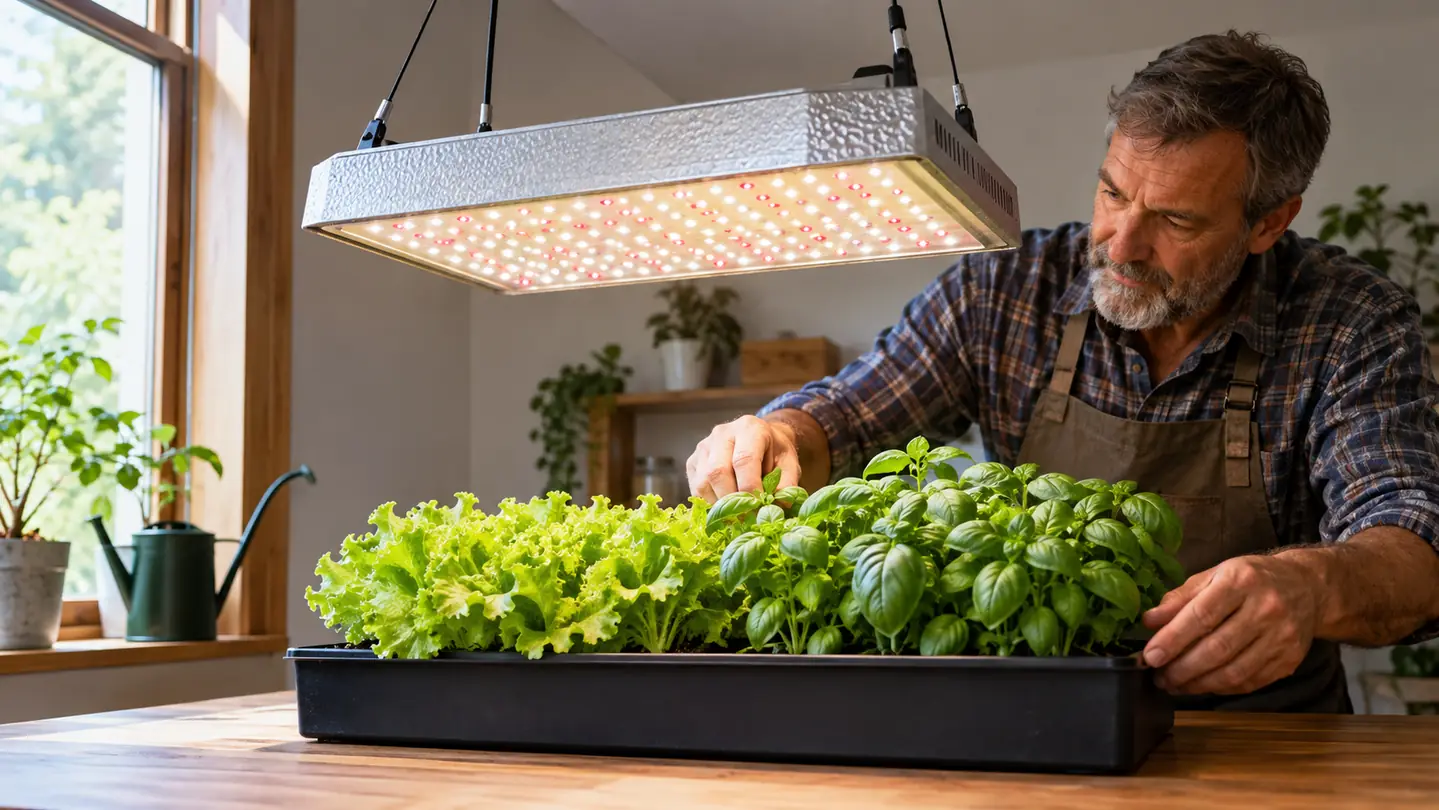
I hung mine at 12 inches for seedlings and raised it to 18 inches as the plants grew. I measured the distance with a plain tape measure, not a light meter, because the hanging cords make it easy to adjust. When the first leaves of my lettuce started looking bleached in late February, I moved the fixture up two inches and turned the dimmer down to 75 percent. Within four days the new growth was dark green again. I wrote the settings in my grow log, dated the entry, and the plants responded within a week. That kind of adjustment is hard to do with a fixed-output bulb.
It runs cool enough for a spare bedroom
My grow room is upstairs, and heat is the first thing I notice when I open the door. The TS1000 stays cool to the touch on the housing, and the fan is quiet. On a mild March afternoon, with the light running at full power for six hours, the room temperature barely moved. I can run it 16 hours a day without turning the room into a sauna, which matters when the only window is a small one facing the backyard.
The power draw is small enough to ignore
At 150 watts, the TS1000 pulls less than a space heater. I run it on a timer with the rest of my setup, and the electric bill barely moves. I checked the difference over a full winter billing cycle: running the light 16 hours a day from November through February added about what I used to spend on a couple of fast-food lunches. For a hobby grower, that matters more than the raw wattage. You can hang the light, set the timer, and not think about the meter again.
Full spectrum light makes leaves look like they should
Under the TS1000, my basil stays deep green instead of stretching pale toward the window. The light covers the red and blue ends of the spectrum, so the plants get what they need without me adding a second bulb. I can see the difference most clearly in late January, when the days are short. The basil on the shelf under the light keeps its color and its shape, while the spare pot I kept on the windowsill as a comparison went thin and yellow within two weeks. Linda noticed the difference before I said anything about it, which is how I knew it was real.
It fits on a standard shelf without a big footprint
The TS1000 is a single fixture, not a huge panel. I mounted it on the underside of my shelving unit with the included hanging hardware, and it covers a 2x2 foot area nicely. I measured the shelf before I ordered the light, and it fit with room to spare on both sides. That is exactly the footprint of one shelf on my unit, so nothing sticks out into the walkway. For a spare bedroom grow room, that footprint is the whole point.
The dimmer gives you a cheap way to experiment
When I first started, I ran the light at full power and my lettuce bolted. The leaves turned bitter and the plant shot up a flower stalk in about ten days. I checked my grow log and realized I had also left the light on 18 hours a day, which was my mistake, not the fixture's. I turned the dimmer down to 75 percent, set the timer to 16 hours, and started a new batch of seed. That batch stayed low and leafy, and we were cutting salads by early April. That kind of adjustment is hard to do with a fixed-output bulb, and it is the reason I tell new growers to keep a notebook.
It is quiet enough to run while you sleep
The fan on the TS1000 is the quietest part of my setup. I run the light on a timer from 6 a.m. to 10 p.m., and I never hear it from the hallway. Linda sleeps in the room next to the grow room, and she has never once complained about the noise. If you grow in a bedroom or a room next to one, that matters more than the specs suggest.
It works with the timer I already owned
I plugged the TS1000 into a cheap mechanical timer I bought at the hardware store, and it has run the same schedule for two years. No smart hub, no app, no firmware update. I set the dial once, and it has clicked on at 6 a.m. and off at 10 p.m. every day since. For a retired HVAC guy who spent thirty years working on complicated systems, that is the right kind of technology.
It is built like a tool, not a toy
The aluminum housing is solid, the cord is long enough to reach my outlet, and the hanging hardware is simple. After two years of daily use, mine still looks and runs like the day I hung it. I have moved it twice, once when I rearranged the shelf and once when I switched the light to the other end of the room, and the mounting brackets have not loosened. The fan has not developed a rattle, and the dimmer still turns smoothly. That is the kind of durability I respect, because I have thrown away enough cheap tools to know the difference.
What I'd Skip
If you are growing a single pot of herbs on a kitchen windowsill, you do not need a 150 watt LED. The TS1000 is for people with a shelf, a spare corner, or a room they can dedicate to the hobby. I would also skip it if you want a light you can control from your phone, because this one is manual, and the dimmer knob is on the driver. And if you are growing tomatoes or peppers to full maturity indoors, you will want more light than a single TS1000 provides. I tried two cherry tomato plants under mine one summer, and they produced, but not enough to justify the shelf space. For leafy greens and herbs, it is plenty. For a bigger harvest, buy two or look at a larger MARS HYDRO fixture.
After two years of daily use, mine still looks and runs like the day I hung it. That is the kind of durability I respect.
The light I'd hang again tomorrow
If you are setting up a home grow room and want one light that does the whole job, the MARS HYDRO TS1000 is the one I would buy again. Check today's price on Amazon and see if it fits your shelf.
Amazon Check Today's Price on Amazon →