
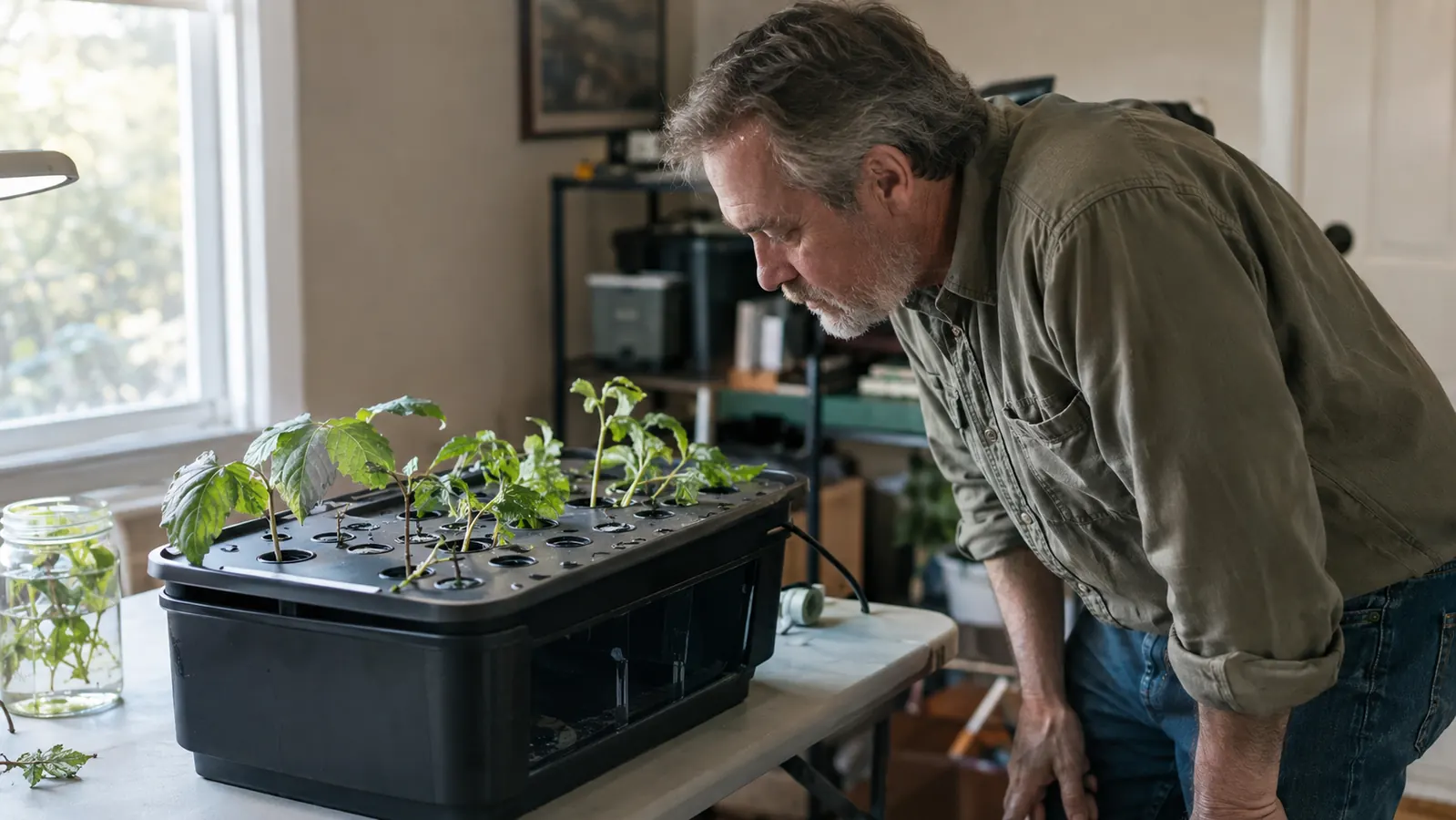
I have rooted cuttings in cups of water, in damp perlite, and in a plastic bag on a windowsill that my wife Linda still brings up at dinner. All of them worked, sort of. Then my back started complaining about the raised beds and I moved most of the growing into a spare bedroom upstairs, and I decided to do this the way I do everything else: buy the right tool, keep a notebook, and stop guessing. That is how the CLONE KING 25-site aeroponic cloner ended up on my workbench in March, and how I ended up with a grow log full of numbers instead of opinions.
This is not a first-week impression. I have run this machine through six batches over about five months, rooted basil, mint, rosemary, tomatoes, and oregano, and kept notes on every one. Here is what I would tell a neighbor who asked whether the CLONE KING is worth the money and the shelf space.
The Quick Verdict
The CLONE KING is the most dependable rooting tool I own. It is not magic and it is not set-and-forget, but if you treat it like a piece of shop equipment, it will root cuttings faster and more consistently than anything else I have tried.
Amazon Check Today's Price →Root cuttings in about half the time of a windowsill
The CLONE KING 25-site aeroponic cloner keeps cuttings misted and oxygenated around the clock. Check today's price on Amazon and see if it fits your grow room.
Amazon Check Today's Price on Amazon →How I've Used It
The unit showed up in a flat box about the size of a small suitcase and took maybe twenty minutes to put together. The pump sits in the base, the misters screw into a manifold, and the neoprene collars drop into the lid. Nothing about it is complicated, which is what I wanted. I filled it with tap water that had sat out overnight to let the chlorine fade, added a little rooting solution, and started my first batch the same day. That was March 14, and I wrote the date in the grow log before I even plugged the pump in.
My routine has been the same since batch one. I take cuttings in the morning, strip the lower leaves, dip them in cloning gel, and set them in the collars. I check the water level every couple of days, top it off when the pump starts to sound different, and change the water between batches. The whole thing lives on a folding table in the spare bedroom, where it gets indirect light from the window and a little help from a shop light I hung over it. I keep a thermometer on the table, because water temperature matters more than people think. Below about 65 degrees the cuttings slow way down. Above about 75 you start growing things you did not plant. I use a cheap cloning gel from the garden center, and I have not found that the expensive stuff roots any faster. What matters is that the cut end is covered and the cutting goes into the machine while the gel is still wet.
I kept a paper grow log before this machine and I kept one after. Every batch got a date, a count, a water temperature, and a note about which cuttings rooted and which did not. I also wrote down the dumb mistakes, because those are the notes you actually learn from. I logged the air temperature in the room too, because a cold snap in April taught me that cuttings stall when the room drops below 60. I added a small space heater that week and did not lose another batch to cold. That notebook is where most of what follows comes from.
What the CLONE KING Actually Does
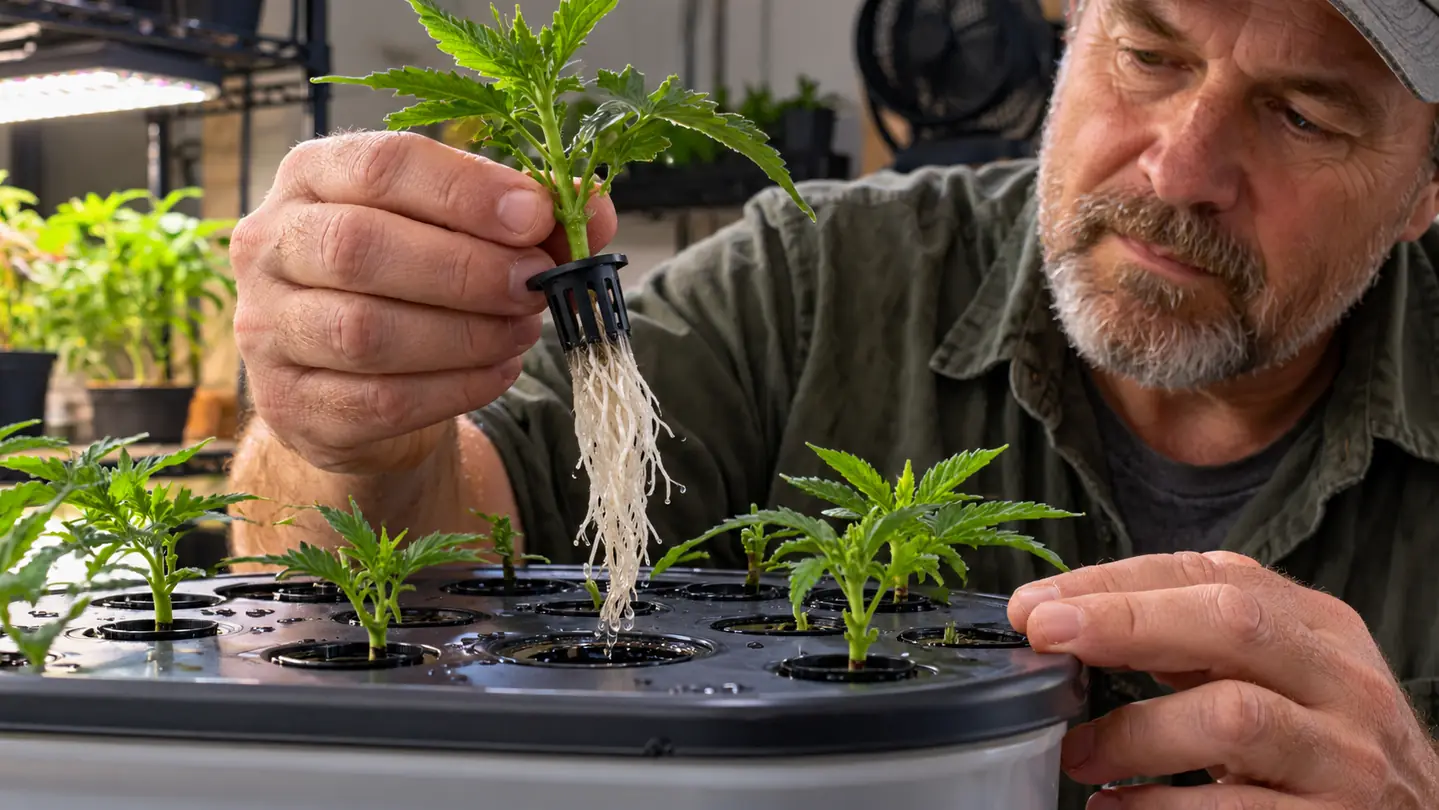
The idea behind aeroponic cloning is simple. The cuttings hang in air, and a pump sprays a fine mist of water and nutrients onto the stems. The mist keeps the cut surface wet, the air keeps oxygen flowing to it, and the plant does what it does: it pushes out roots. No soil, no perlite, no cups of water on the sill. The first time I lifted the lid after a few days, I could see the mist hanging in the chamber like a fog and every stem was beaded with water. That is the whole system. There is not much to go wrong.
The CLONE KING runs that mist continuously. That is the part that matters. A timer that cycles the pump on and off can let cuttings dry out if the interval is wrong, and dry cuttings are dead cuttings. The continuous mist is the reason I stopped losing the bottom row of a batch to dehydration. The pump is a small submersible unit, the same kind you would find in a fish tank, and it moves water up through the manifold and out through the misters. I counted eight misters on the manifold when I assembled it, and they put out a cone of mist that covers the whole chamber. When one of them clogged in batch five, I found it fast because the cuttings in that corner looked dull. Ten minutes with a toothpick and it was spraying again.
The 25 sites sound like a lot for a home grower, and they are. I rarely fill all of them. But the extra sites mean I can run a batch of tomatoes and a batch of basil at the same time, or root a dozen cuttings and leave the rest empty. The machine does not care if a site is empty, and neither do I. The collars come in two sizes in the bag, and I use the small ones for basil and the larger ones for tomatoes. Swapping one takes about ten seconds. The collars hold stems about a quarter inch thick without crushing them, and they grip firmly enough that I can lift the whole lid by one cutting without it slipping. I also learned to leave the lid cracked for the first day so the cuttings can breathe, then close it up once the leaves stop wilting.
Rooting Results Over Six Batches
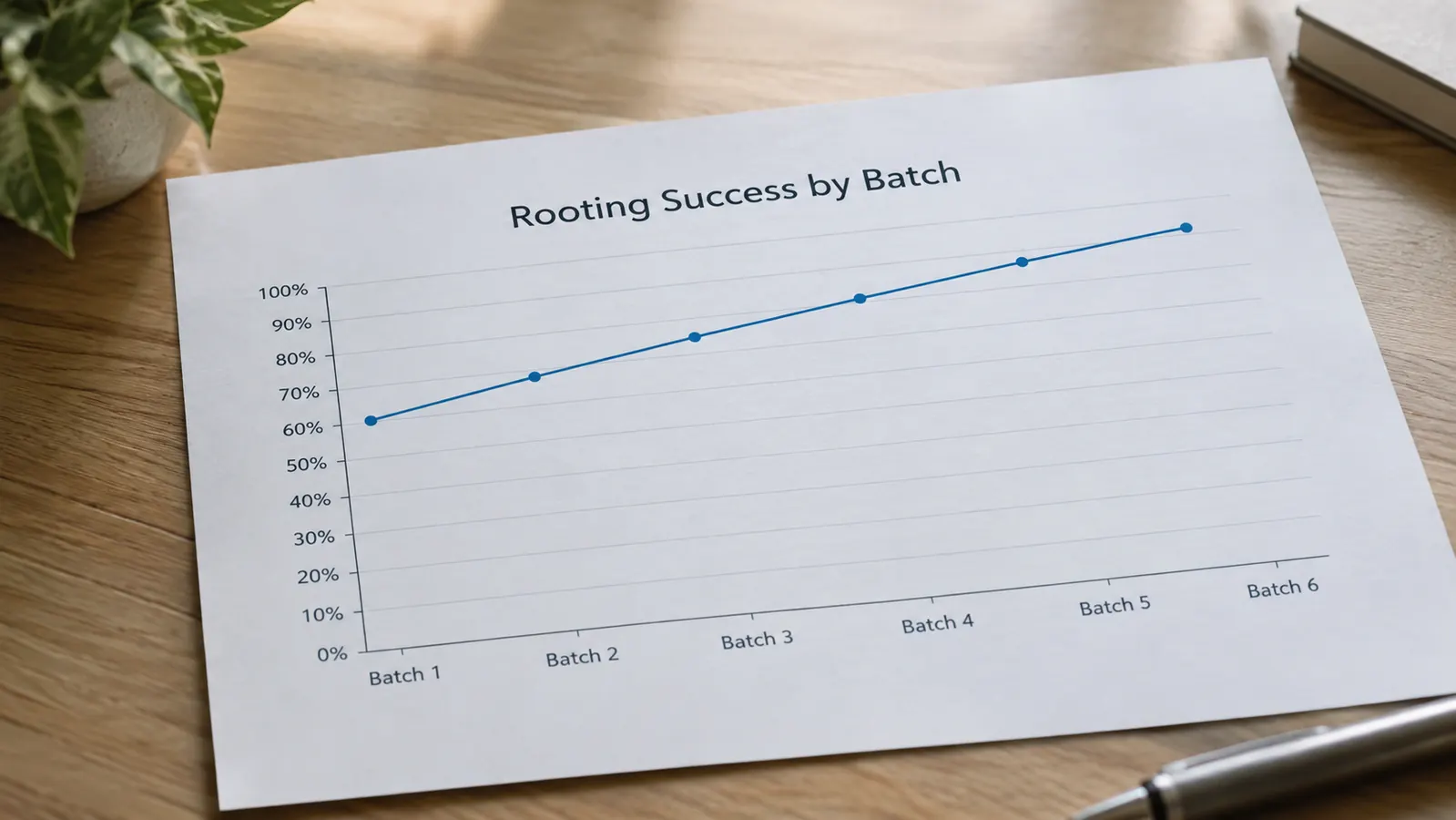
Batch one was basil, and it was a near-total success. Twelve of twelve cuttings rooted in nine days. I took them from a store-bought plant on March 14, and by March 23 the roots were long enough to pot up. I potted them into four-inch pots with regular potting mix, and they never looked back. Batch two was rosemary, which is slower and fussier, and I got eight of ten. The two that failed were the ones I took from the oldest part of the plant, and I made a note to only use new growth from then on. Rosemary took a full three weeks, but it rooted. Batch three was tomatoes, and that is where I learned the first lesson: I left the cuttings too long before taking them, and the stems were woody. Five of ten rooted. The machine was fine. My timing was not.
Batch four was mint, and it rooted so fast I almost missed it. Seven days and the roots were long enough to pot up. I potted eight of them and gave a couple to Linda for the kitchen window. Batch five was a mix of basil and oregano, and I got nineteen of twenty. The one failure was a cutting I dropped on the floor while I was carrying it to the machine, and I put it in anyway. It rooted, but slowly, and I tossed it at potting time. Batch six was another round of tomatoes, this time with cuttings taken from young growth in the morning instead of old growth in the afternoon, and I got nine of ten.
Add that up and it is fifty-three of sixty-two cuttings rooted, about eighty-five percent overall. The failures were mine, not the machine's. Woody stems, cuttings taken too late in the day, and one batch where I let the water level drop and the pump sucked air for an afternoon. I caught it when the pump started to whine, added water, and the cuttings perked back up by the next morning, but two of them never rooted properly. I also stopped watering the mother plants the day before I took cuttings. It sounds backwards, but cuttings from slightly thirsty plants seem to root faster because they are already looking for water. The CLONE KING does not fix sloppy technique. It just makes good technique pay off faster.
Fifty-three of sixty-two cuttings rooted over five months. The failures were mine, not the machine's.
What I Like, and What I Do Not
The best thing about the CLONE KING is the roots. They show up in days, not weeks, and they look like white threads instead of the brown nubs I got from perlite. Basil roots in about nine days. Mint in seven. Even the slow rosemary was ready to pot up in about three weeks, which is about half the time it took me in cups of water. By the time I pot up a cutting, the roots are usually two or three inches long and branching, and the whole plug of roots lifts out of the collar in one piece. With perlite I was lucky to get a single taproot that tangled in the grit and broke when I pulled it free.
The second best thing is the cleanup. The base is one piece of molded plastic, the lid lifts off, and the misters pull out. I rinse everything in the tub between batches and it is ready to go again. No soil to wash out of the roots, no perlite dust on the floor. The whole job takes about fifteen minutes, and I do it in the utility sink downstairs. I also wipe the lid with a little diluted bleach once a month, because algae will find any wet surface if you give it time.
The thing I do not like is the noise. The pump is not loud, but it is constant, and in a quiet house you notice it. I moved the machine to the far end of the spare bedroom and closed the door at night. It is a hum, not a roar, but it is always there. Linda says she can hear it from the hallway, and she is not wrong. The only time it really got to me was a stretch in July when the windows were open and I could hear it from the back porch while I was trying to read. If you plan to run this in the room where you watch television, think about where the machine is going to sit before you buy it.
The other thing I do not like is the water level. The reservoir is not see-through, so I cannot tell at a glance how much is left. I learned to check it every morning with a flashlight. Miss a day in the summer and the pump starts to sound thin, and that is the sound of trouble. That happened in batch five, and it cost me two cuttings. I fixed the problem with a piece of white tape on the outside of the base at the fill line, so I can see the level from across the room without bending over. It is not elegant, but it works. I also keep a one-gallon jug of tap water next to the table, so topping off takes less than a minute.
What I Liked
- Roots cuttings in about half the time of my old methods
- Continuous mist means no dry cuttings, even in the back row
- Easy to take apart and rinse between batches
- 25 sites give room to run two crops at once
- Simple construction, no electronics to fail
Where It Falls Short
- Pump hum is constant and you will hear it in a quiet room
- Reservoir is not see-through, so you have to check the level by hand
- No timer or controller, you are the timer
- Bigger than it looks in the photos, needs a real table
Who This Is For
This is for the home grower who has rooted cuttings the slow way and is tired of losing half of them. If you have a spare shelf, a table, or a corner of a room, and you want basil in nine days instead of three weeks, the CLONE KING will do that. It is also for the person who likes a tool that does one thing and does it well, with no app, no subscription, and no parts that need replacing every season.
It is especially good for tomatoes. I have never had tomato cuttings root as fast or as reliably as they do in this machine. If you grow tomatoes indoors or on a porch and you want to keep the same plant going year after year, this is the tool for that job.
Who Should Skip It
Skip it if you only root a few cuttings a couple of times a year. A glass of water on the sill will get you there eventually, and the CLONE KING takes up real space and makes a constant hum. Skip it if you want something fully automatic. This machine has one moving part and no brain. You are the brain, and if you forget to check the water, you will pay for it.
And skip it if you are looking for a way to root every cutting of every plant, every time. No machine does that. The CLONE KING gets you from maybe half to most, and it gets you there faster, but it will not fix a cutting taken from a plant that is not ready.
Root most of your cuttings, not half of them
The CLONE KING 25-site aeroponic cloner is the most dependable rooting tool I have used in four years of indoor growing. Check today's price on Amazon and see if it earns a spot on your table.
Amazon Check Today's Price on Amazon →