

I started growing indoors about four years ago, after a back problem made bending over the raised beds out back a losing proposition. My wife Linda wanted basil and lettuce year round, and I wanted a project I could manage standing up. So I cleared out the spare bedroom upstairs, put up a shelf, and started reading. After 38 years as an HVAC tech, pumps and timers did not scare me. Nutrients were a different animal. The first nutrient line I tried was the General Hydroponics Flora Series, because every forum thread I found circled back to those three bottles. This review is what happened after months of real use, not a weekend trial.
If you are looking for a plain answer up front: the Flora Series works, it is forgiving, and I am still using it. But there are a few things I wish somebody had told me before I bought it, and a few places where it is not the right choice at all.
The Quick Verdict
A dependable three-part nutrient system that is hard to outgrow and easy to fix when things go wrong. Not the cheapest per bottle, not the simplest for a total beginner, but the most forgiving line I have used in my grow room.
Amazon Check Today's Price →The three-bottle system I have kept on my shelf for a full season
After months of lettuce, basil, and peppers, the Flora Series is still what I reach for when I mix a fresh reservoir. See today's price on Amazon and decide if it fits your grow room.
Amazon Check Today's Price on Amazon →How I've Used It
My setup is not fancy. A converted spare bedroom upstairs, a four-foot LED fixture, and a couple of rubbermaid totes I turned into reservoirs. I grow lettuce and basil in a small aeroponic unit on the shelf, and I have run peppers in a five-gallon bucket with an air stone. City tap water, which I let sit out overnight before I mix anything into it. The aeroponic unit holds six plants in a 2x2 foot tray, with a pump on a timer that runs 30 seconds on, 5 minutes off. The bucket has four net pots in the lid.
I kept a paper grow log from day one, the same habit I had as an HVAC tech. Every reservoir change, every pH reading, every dosage change is in it. I ran the Flora Series through a full winter cycle of lettuce and basil, then a summer run of peppers. The bottles are the one-quart size, and a quart of each lasted about four months. I mixed fresh nutrient every seven days for lettuce and every ten days for peppers. On the first of every month I dumped the reservoir and scrubbed the bucket with a soft brush.
The feeding schedule on the bottle is written for aggressive commercial growth. I ran it at about half strength for leafy greens and never saw a deficiency. When I pushed peppers harder in flower, I followed the bottle more closely and still never burned a plant. For lettuce I mixed 2.5 ml of FloraGro and 2.5 ml of FloraMicro per gallon, skipping FloraBloom. For basil I added 1 ml of FloraBloom once the plants had four true leaves. For peppers in flower I used 3 ml of FloraMicro, 2 ml of FloraGro, and 3 ml of FloraBloom per gallon. Those ratios are what ended up taped to my shelf.
What the Three Bottles Actually Do
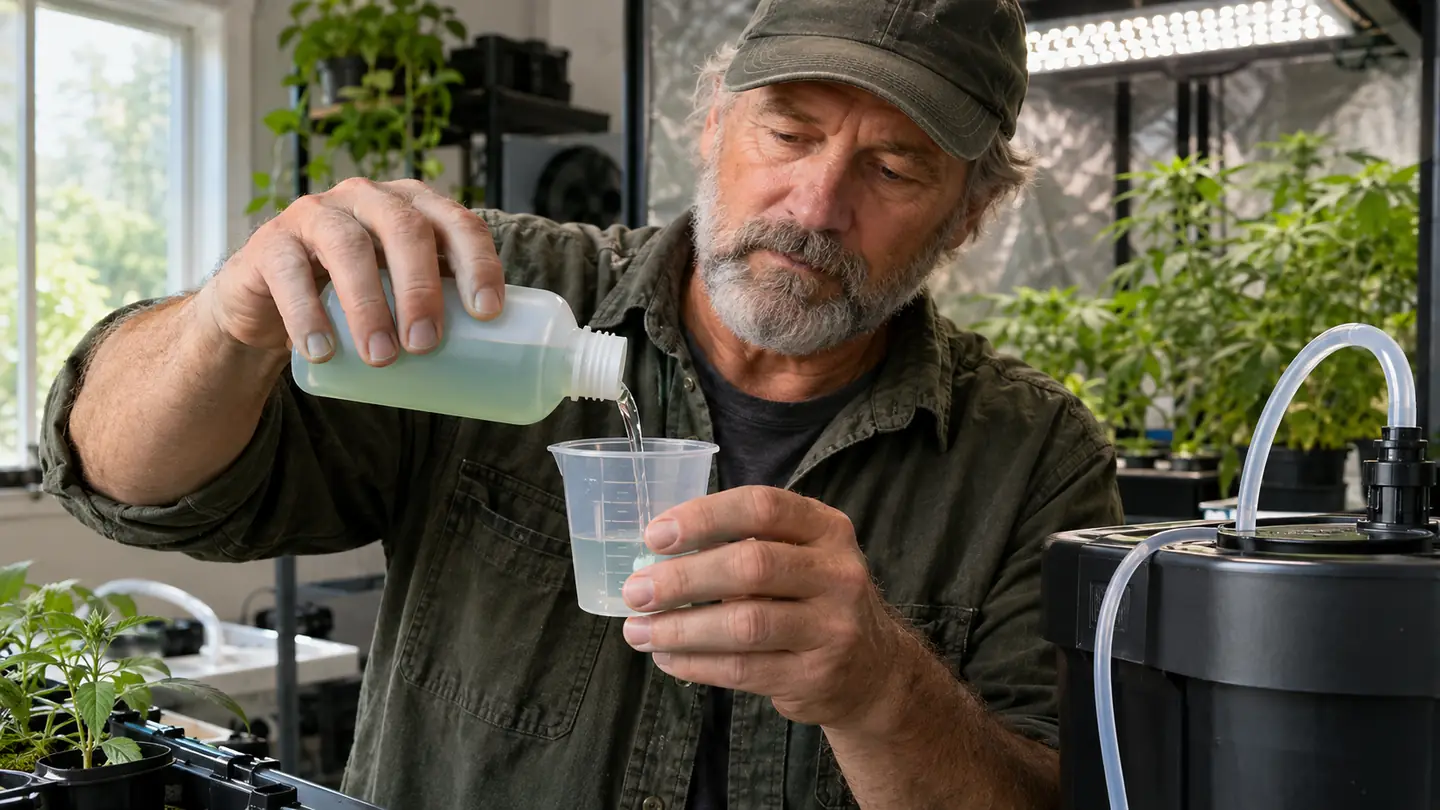
The General Hydroponics Flora Series is a three-part system: FloraGro for vegetative growth, FloraBloom for flowering and fruiting, and FloraMicro for the micronutrients and trace elements. You mix them in different ratios depending on where the plant is in its life. A young lettuce plant gets mostly FloraGro and FloraMicro. A pepper plant setting fruit gets mostly FloraBloom and FloraMicro. The three numbers on each label are nitrogen, phosphorus, and potassium, and being able to move one of them without touching the other two is the whole point.
That sounds complicated, and the first time I mixed a reservoir I stood there with the bottles and a calculator like a man defusing a bomb. But the ratios are printed on the bottles, and after two or three mixes it becomes routine. If your plants need more nitrogen, you add FloraGro. You do not have to buy a separate bottle and guess how it interacts with everything else. In late February my basil leaves started turning lighter green at the edges while the veins stayed dark. That is a classic magnesium issue, so I added an extra 1 ml of FloraMicro per gallon for one reservoir change. The color came back in about five days.
The FloraMicro is the one to watch. It is the most concentrated of the three, and it is the one that will drop your pH if you are not careful. I learned to add it to the water first and mix well before adding the other two. That single habit fixed most of the pH drift I fought in the first month. I also mix each dose in a separate one-cup measure before pouring it into the reservoir, which cut my measuring errors way down.
How It Performed Over Time
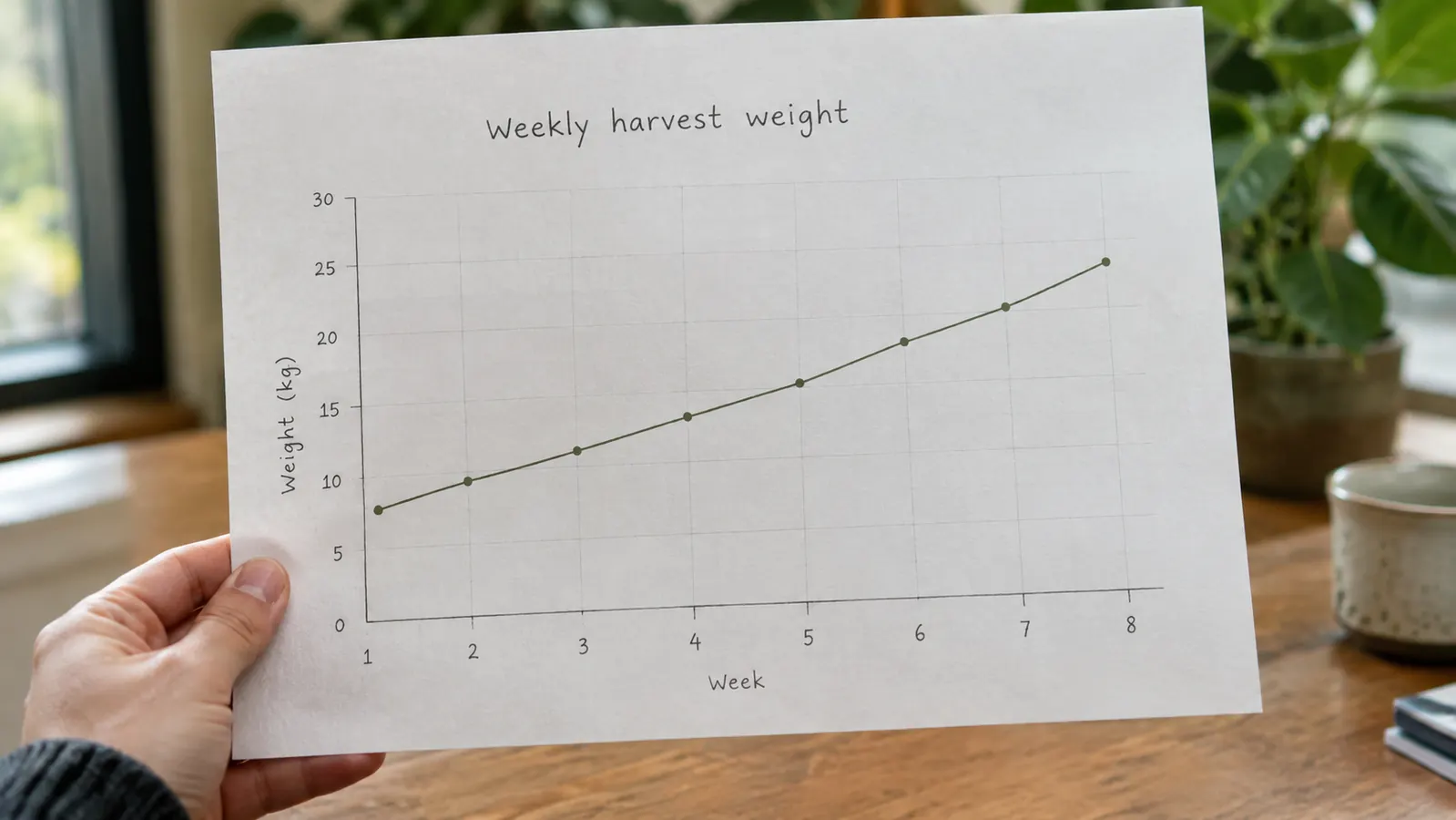
The lettuce was the first real test. I started with a tray of romaine in the aeroponic unit in early November. By the third week I was cutting leaves for salads, and by the end of January I had harvested about two pounds a week from a unit that takes up maybe four square feet of shelf. Linda stopped buying lettuce at the store in December. I cut outer leaves with kitchen scissors every four or five days, and by mid-January my log showed weekly totals between two and two and a half pounds.
The basil did even better. I have never had basil that dark green or that fragrant from a seed-starting mix. I attribute most of that to the FloraMicro, because the trace elements are what make the difference between a plant that is alive and a plant that is thriving. The peppers were the harder test. I moved two plants to the back porch in May and fed them the bloom ratio through the summer. I got a steady run of fruit from July through September, maybe thirty peppers off two plants. Nothing that would impress a commercial grower, but plenty for salsa and for giving a few away. I started the basil from seed in rockwool cubes on a heat mat; by week six I was pruning it every Sunday. The peppers came from seeds I saved from a store-bought jalapeno in April. We picked the first ripe pepper on the 14th of July, and my log lists 31 peppers for the season.
The one thing that surprised me was how stable the solution stayed. I checked pH every morning for the first month, then every other day once I trusted it. With city water that had been sitting out, the pH drifted slowly upward over about a week, and a few drops of pH down brought it back. I never had a sudden crash or a reservoir that went foul overnight. My tap water settles around 7.4 pH, and after mixing the Flora Series at half strength it came in around 6.2. The drift was about 0.2 pH a day, so a reservoir mixed on Sunday was still fine on Thursday. I never saw the brown slime some forums blame on nutrients, though I do not know whether that is the Flora Series or my weekly scrubbing.
The trace elements in FloraMicro are the difference between a plant that is alive and a plant that is thriving. I saw it in the color of the basil within two weeks.
The Tradeoffs Nobody Mentions
The first tradeoff is the measuring. Three bottles means three measurements every time you mix. I solved it with a permanent marker and a piece of tape on each bottle: G for gro, B for bloom, M for micro. I also wrote the ml per gallon numbers on the tape. For my 2.5-gallon reservoir I measured out 6.25 ml of each part with a 10 ml syringe I bought at the pharmacy. The first week I double-checked every measurement; by the third week I could do it with a coffee cup in one hand.
The second tradeoff is the math. The bottle ratios are given in teaspoons or milliliters per gallon, and if your reservoir is not a round number of gallons, you are doing fractions. I mix in a five-gallon bucket and then pour, so the math stays easy. My aeroponic reservoir holds 15 liters, which is 3.96 gallons, so for lettuce at half strength I rounded 9.9 ml up to 10 ml and never noticed the difference. I keep a plastic bin with a measuring cup and a small scale dedicated to nutrients, and I tare the cup each time.
The third tradeoff is the one that almost made me switch: the FloraMicro stains everything it touches. I spilled a few drops on a white countertop and it left a brownish mark that took bleach to remove. It also stains a measuring cup if you do not rinse it right away. This is cosmetic, not functional, but worth knowing before you mix your first batch in the kitchen. I keep vinegar and paper towels at the mixing station and wipe spills within a minute.
The fourth tradeoff is cost per bottle. The General Hydroponics Flora Series is not the cheapest nutrient line per quart, and if you are growing a single lettuce plant in a windowsill, a one-part mix will do the same job for less money. The Flora Series earns its keep when you have a real grow room and a real harvest schedule, because the control it gives you pays for itself in fewer problems and steadier yields. When I divided the bottles I used over the winter by the weight of lettuce and basil I harvested, the nutrient cost per pound was lower than what we were paying for organic greens at the store.
Who This Is For
The Flora Series is for the home grower who wants to treat growing like a project. If you keep a notebook, if you like knowing why a plant looks the way it looks, if you are willing to spend ten minutes measuring and mixing instead of five, this system will reward you. The ability to adjust the three parts independently is what lets you fix a nitrogen problem without creating a phosphorus problem. I keep a three-ring binder, and every Saturday I write down the pH, the room temperature, and how the plants look. That habit is what lets me say the Flora Series was not the source of my problems.
It is especially good for aeroponic and hydroponic growers, because the Flora Series is formulated to stay in solution without falling out. I have run it through fine misters and through air stones, and I have never had a clogged nozzle or a residue problem. That alone is worth something, because a clogged mister in an aeroponic unit is a dead plant by the end of the day. I have also used it in a cheap DWC bucket with a cheap air pump, and the solution stayed clear.
Who Should Skip It
If you are brand new to growing and the idea of mixing three bottles makes your eyes glaze over, start with a one-part mix. The Flora Series will not save you from learning about pH, and it adds a layer of measuring on top of everything else you are already learning. My first season I used a one-part all-purpose nutrient and it was fine. I learned about pH the hard way when the reservoir went sour. If I had started with the Flora Series at the same time, I would have had to learn nutrient ratios and pH at once, and I probably would have blamed the nutrients for every mistake.
If you are growing a single houseplant or a small herb pot in the kitchen, this is overkill. A one-part liquid fertilizer will do the job for a fraction of the effort. And if you are growing in soil outdoors, the Flora Series works, but you are paying for water-soluble precision you do not really need in a garden bed. Linda keeps two African violets on the kitchen windowsill and she uses the same one-part houseplant food she has had for years. The Flora Series assumes you have a reservoir, a pump, and a pH kit.
What I Liked
- Three-part design lets you adjust nitrogen, phosphorus, and potassium independently
- Forgiving for home growers; half-strength feedings still produced healthy lettuce and basil
- Stays in solution well, no clogged misters in my aeroponic unit
- Clear printed ratios on the bottles, easy to scale up or down
- A full season of steady harvests from one set of quart bottles
Where It Falls Short
- Three bottles means more measuring and more math than a one-part mix
- FloraMicro stains counters and measuring cups if you spill it
- Not the cheapest option for a single plant or a windowsill herb pot
- You still need a separate pH kit and pH adjusters
Ready to mix your first reservoir?
The Flora Series is the three-bottle system I have kept in rotation for a full season of home growing. Check today's price on Amazon and see if it earns a spot on your shelf.
Amazon Check Today's Price on Amazon →