
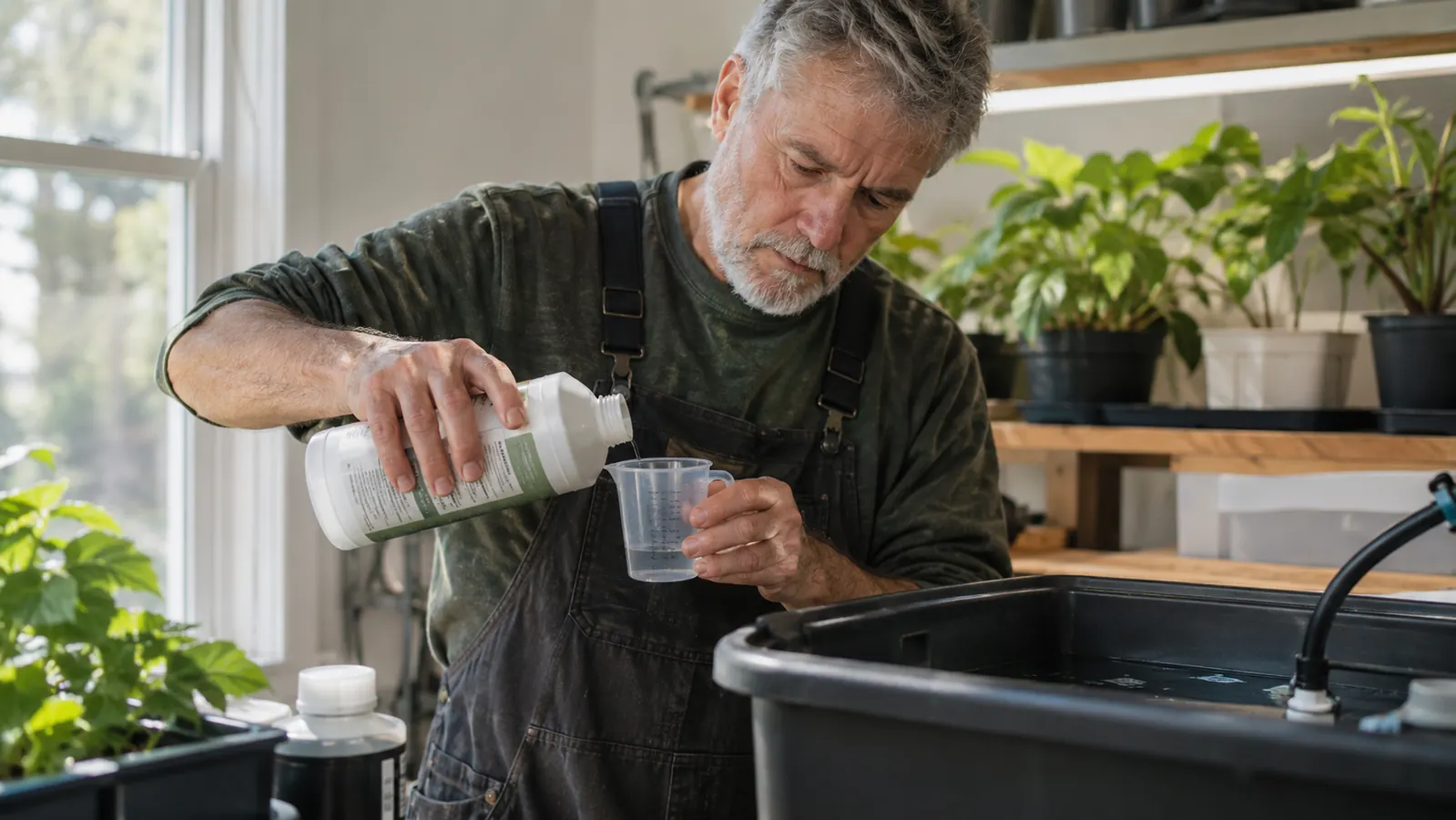
The first time I mixed hydroponic nutrients, I dumped all three bottles into the reservoir at once and stirred. The next morning the pH had swung a full point and the lettuce looked angry. My wife Linda said the grow room smelled like a swimming pool. That was four years ago, and the fix turned out to be simple: mix the parts in the right order, measure everything, and write it down. This guide walks through the exact routine I use now with General Hydroponics Flora Series, the three-part system that has been the backbone of my setup since I started growing indoors.
If you are new to hydroponics, the Flora Series can look complicated because it comes as three separate bottles: FloraGro for growth, FloraBloom for flowering and fruiting, and FloraMicro, which carries the chelated trace elements. The label has a feeding chart with ratios like 3-2-1 and 1-2-3, and it is easy to overthink. The truth is that the system is forgiving if you follow a few rules. Mix the Micro first, add the others after, and let the water do the work.
The three-part system that made my mixing routine boring, in the best way
General Hydroponics Flora Series is the set I reach for every time I refill the reservoir. It is a complete three-part nutrient system in 1-quart bottles, and it is the same lineup I have used for four straight years of indoor growing.
Amazon Check Today's Price on Amazon →Step 1: Fill the reservoir and let the water sit
I use city tap water, and I have learned not to mix nutrients straight from the faucet. Chlorine and chloramine need time to dissipate, and cold water also makes the nutrient liquids behave differently. I fill the reservoir the night before I plan to mix, then leave it open overnight. By morning the water is room temperature and the chlorine smell is gone. On a cold January night, when the house thermostat is set to 68, the water in that reservoir will still be a few degrees below the 70 to 72 I like, so I give it an extra hour with the air stone running before I add anything.
How much water you need depends on your system. My reservoir holds about 12 gallons, and I usually mix a fresh batch every 10 to 14 days. If you are running a smaller countertop unit, you might only need a gallon or two. The important thing is to know your reservoir volume before you start, because every measurement in the rest of this guide depends on it. I learned that the hard way when I first used a 5-gallon bucket and guessed at the amounts, then wondered why the plants looked worse instead of better.
One note: if your water is very hard or very soft, it is worth testing it once with a cheap TDS meter. I did, and it explained why my early batches were inconsistent. My tap water reads around 180 parts per million out of the faucet, and in the summer it can climb to 220. The Flora Series works fine with most tap water, but knowing your starting point makes the whole process more predictable. It also tells you when the water itself is the problem, not the nutrients.
Step 2: Add FloraMicro first, and stir it in
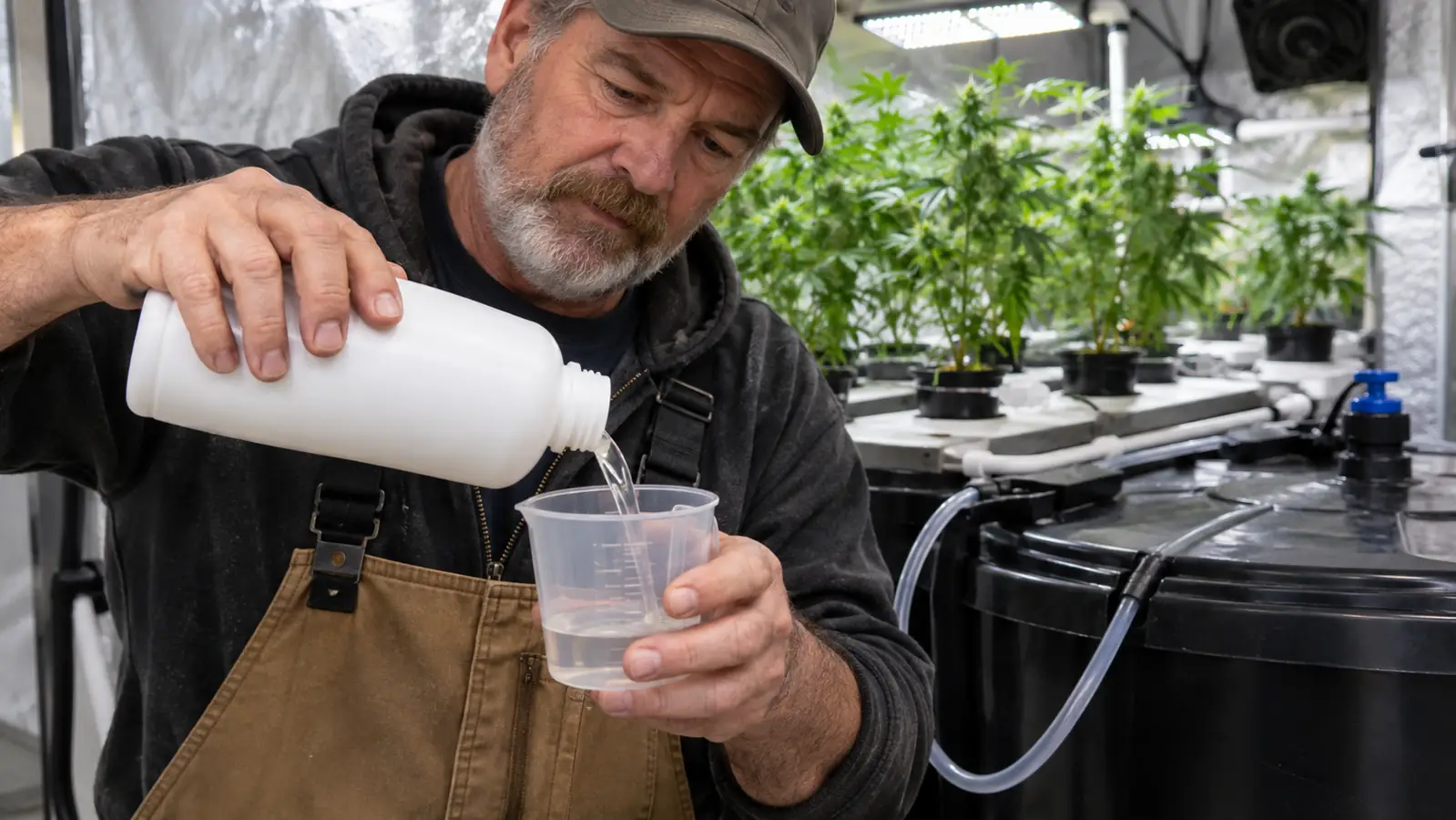
This is the rule that took me the longest to learn, and it is the one I break at my own peril. FloraMicro contains the chelated trace elements, and it needs to go into the water before the other two parts. If you add FloraGro or FloraBloom first, the minerals can bind together and fall out of solution. That is the cloudy mess I created on day one, and it is also why the pH swung so hard. I remember standing over that reservoir watching the water turn milky and thinking I had just ruined a whole batch of lettuce.
The General Hydroponics feeding chart gives ratios like 3-2-1 for vegetative growth, meaning three parts FloraGro, two parts FloraMicro, and one part FloraBloom. But the order is always the same: Micro first, then Gro, then Bloom. I measure the Micro into a separate cup, pour it into the reservoir, and give the water a good stir with a plastic paddle before I add anything else. The paddle is an old kitchen spoon I marked with a notch at the 12-gallon level, and it has been doing that job for three years.
How much Micro depends on your target strength. For seedlings and young plants, I run about a quarter of the label rate. For mature leafy greens in the vegetative stage, I run the full 3-2-1 ratio. The bottles have markings on the side, and I use a graduated cup for anything smaller than a capful. Measuring twice has saved me more batches than I can count. One evening last spring I got distracted by a phone call and nearly poured the Micro straight into the reservoir without measuring. I caught myself, put the bottle down, and started over with the cup.
Step 3: Add FloraGro and FloraBloom, one at a time
Once the Micro is in and stirred, I add FloraGro. I pour it slowly into the moving water, not straight into a still corner of the reservoir. Then I stir again and wait a minute or two before adding FloraBloom. The idea is to give each part time to dissolve and disperse before the next one goes in. If you pour all three in fast, you are basically recreating the mess I made on my first try, and the plants will let you know.
For leafy greens and herbs, I mostly stay in the vegetative ratio, which means FloraGro does the heavy lifting and FloraBloom stays low. When I move peppers or tomatoes into the flowering stage, I flip the ratio so FloraBloom leads. The Flora Series is designed for this kind of adjustment, which is the main reason I have stuck with it instead of switching to a one-bottle formula. Last year I ran a 1-2-3 ratio on a pair of tomato plants from early July through September, and the difference in fruit set was plain to see.
A practical tip: keep a separate measuring cup for each bottle. The liquids are concentrated, and cross-contamination between the caps is easy. I use three plastic cups labeled with a permanent marker, and I rinse them after every mix. It takes thirty seconds and it keeps the bottles from turning into a science experiment. I also wipe the threads of each bottle before I put the cap back on, because dried nutrient crystals will eventually make a cap stick or leak.

Step 4: Check pH and adjust, then check it again
After all three parts are in, I let the reservoir circulate for about fifteen minutes before I test anything. The pH will drift as the nutrients dissolve, so testing immediately after mixing gives a false reading. I use a digital pH pen, and I calibrate it every couple of weeks. For most leafy greens, I aim for a pH between 5.8 and 6.2. For the tomatoes and peppers, I let it run a little higher, around 6.0 to 6.4, because that is where they seem happiest in my setup.
If the pH is high, I add pH down a few drops at a time, wait, and test again. If it is low, I add pH up. The mistake I made early on was trying to correct a full point in one shot. That overshoots every time. Slow and steady is the way, and the Flora Series is stable enough that small adjustments hold for days. I keep a small plastic syringe for this job, because drops from a bottle are too imprecise for a 12-gallon reservoir, and I write down every drop I add.
I also check the EC or TDS at this point, mostly to confirm I did not overdo it. The Flora Series bottles give target ranges on the label, and I have learned to trust the lower end of those ranges. Plants can handle a little less food far better than they can handle a lot too much. One time I doubled the Bloom on a pepper plant because I wanted bigger fruit, and the leaf tips burned within a week. The log showed me exactly what I had done, and I have not repeated it.
Step 5: Write it down and keep a log
I have kept a paper grow log since day one, and it is the single best habit I have in this hobby. Every time I mix a batch, I write the date, the water volume, the exact amounts of each part, the pH before and after adjustment, and the EC reading. When something goes wrong two weeks later, I can look back and see exactly what I did. That is how I caught the bad batch of pH down I bought last fall, which was throwing my readings off by half a point no matter how much I added.
The log is also how I figured out that my tap water changes with the seasons. In the summer, the pH runs higher and I need more pH down. In the winter, the water is colder and the nutrients take longer to dissolve. None of that was obvious until I had six months of entries to compare. I can flip back to March and see that I used 4 milliliters of pH down for a 12-gallon batch, then flip to August and see that the same batch needed 7.
You do not need a fancy app or a spreadsheet. A spiral notebook and a pen work fine. The point is to make the routine repeatable, because repeatable is what gets you from a hobby that struggles to a hobby that produces fresh basil and lettuce most of the year. I date every entry, and I leave a blank line between batches so the page does not turn into a wall of numbers. It sounds fussy, but it takes two minutes and it has saved me more than once.
What Else Helps
The Flora Series will do the heavy lifting, but a few cheap tools make the whole routine easier. A good pH pen is worth the money, and so is a TDS meter. I also use an air stone in the reservoir to keep the water moving between feedings, which helps the nutrients stay suspended. And I keep a small plastic syringe for measuring pH up and down, because drops from a bottle are too imprecise for a 12-gallon reservoir. A plastic paddle or long spoon for stirring is another thing I would not want to be without.
One more thing: change the reservoir on a schedule, not just when it looks dirty. I do a full change every two weeks, and I clean the reservoir with a mild hydrogen peroxide solution between batches. That routine has kept my roots white and my reservoir free of the slime that shows up when you let things slide. I also rinse the air stone in the same solution, because a clogged stone will quietly cut the oxygen in the water and the plants will slow down for no obvious reason.
The day I started mixing Micro first and writing everything down is the day my plants stopped looking like they were mad at me.
Start with the three-part system that makes mixing hard to get wrong
General Hydroponics Flora Series is the nutrient line I have used for four years of indoor growing. It is a complete three-part system in 1-quart bottles, and it is the same lineup I reach for every time I refill the reservoir.
Amazon Check Today's Price on Amazon →