
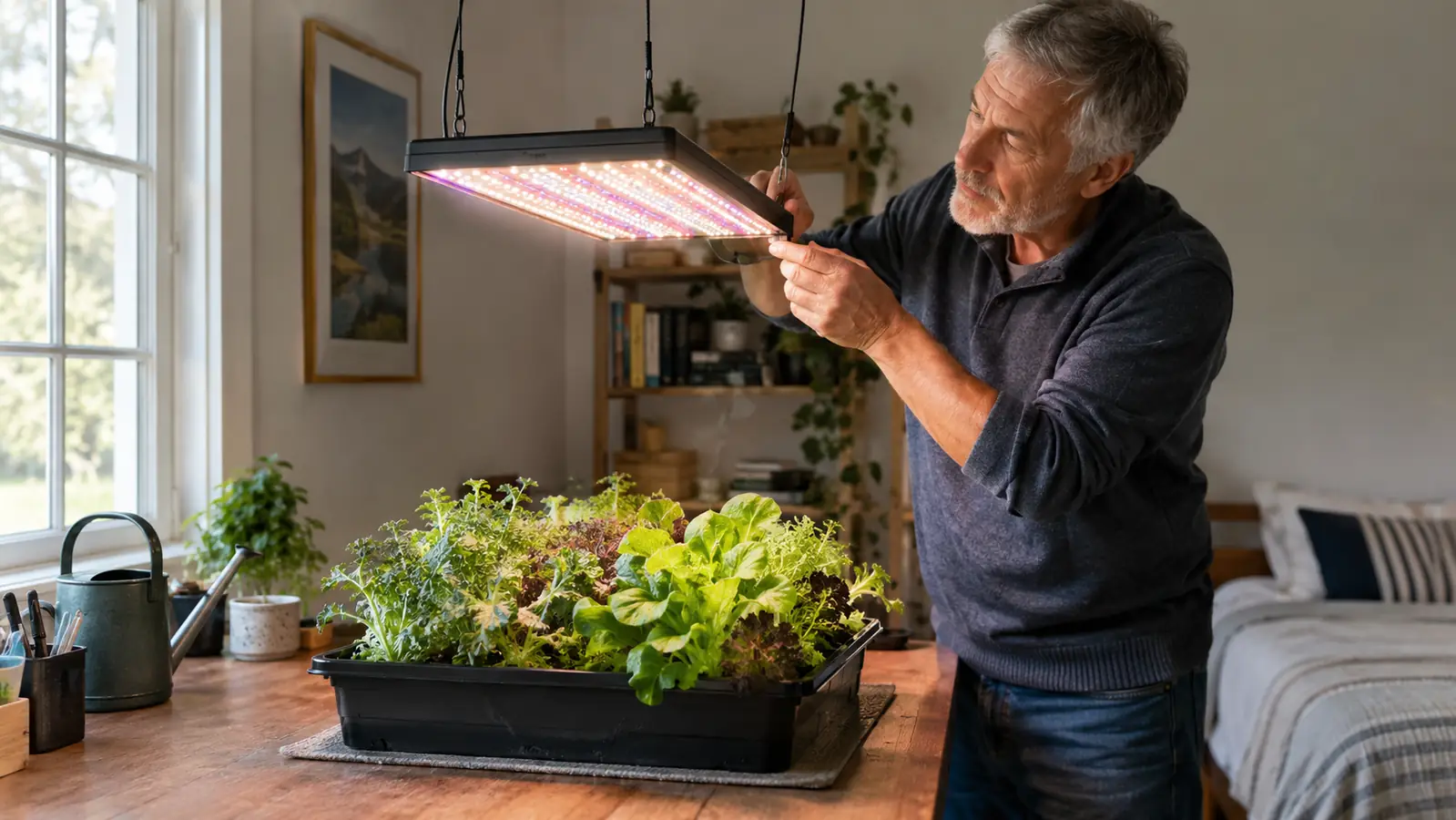
Four years ago, when my back started complaining about the raised beds out back, I moved my growing operation indoors. That meant taking over a spare bedroom upstairs and having a calm conversation with my wife Linda about what counts as a reasonable hobby. She agreed, on one condition: the basil and the lettuce had to keep coming. I keep a paper grow log, the kind you write in with a pencil, and I measure everything twice. So when I tell you I have spent the last eight months growing under a Mars Hydro TS1000, I mean I have the notes to prove it. This is the honest review I wished I had found before I bought mine, written for home growers who want the truth and not a sales pitch.
The short version is this. The TS1000 is a 150 watt full spectrum LED grow light aimed at home growers with one small area, and it has been a very good tool for me. It is not the right light for everybody, and there are a few things the product page does not spell out. Some of those things are small, like the hum from the driver. Some of them matter more, like the size of the area it truly covers. This review covers what it does well, where it falls short, and who should think twice before ordering one. I have no reason to sugarcoat any of it.
The Quick Verdict
A dependable, quiet 150 watt full spectrum light for a single shelf or small grow area, with real caveats around coverage and heat.
Amazon Check Today's Price →The light that earned a permanent spot in my grow room
After eight months of daily use, the Mars Hydro TS1000 is the light I would buy again tomorrow. It has limits, and I lay them out below. Check today's price on Amazon and see if it fits your space.
Amazon Check Today's Price on Amazon →How I've Used It
My setup is about as simple as it gets. I grow in a converted spare bedroom upstairs, about 8 by 10 feet, with a 2 foot by 2 foot tray of lettuce and basil sitting on a sturdy table I built from plywood and 2x4s. The TS1000 hangs from a wire shelf frame using the hanging wires and ratchet hanger that come in the box. I keep the light 18 inches above the canopy, which is the middle of the range in the manual, and I run it 14 hours a day in spring and fall and 16 hours in the dead of winter. A cheap mechanical timer turns it on and off, because the light does not have one built in.
Linda cares about two things in this room: the basil and the lettuce. Both have done well. My grow log shows I started seeds under this light in early October and harvested through the end of May without buying a single head of lettuce. I use city tap water that sits out for a day before I mix nutrients, and I feed at half strength. The light does the heavy lifting. My job is mostly keeping the schedule and checking the water level in the tray every morning with my coffee.
I started growing indoors about four years ago, after my back made bending over raised beds painful. I have kept a paper grow log since day one, and it is full of notes about lights, temperatures, and the mistakes I made along the way. That log is why I trust my opinion on this light. It is not a memory. It is a record.
What the TS1000 Actually Is
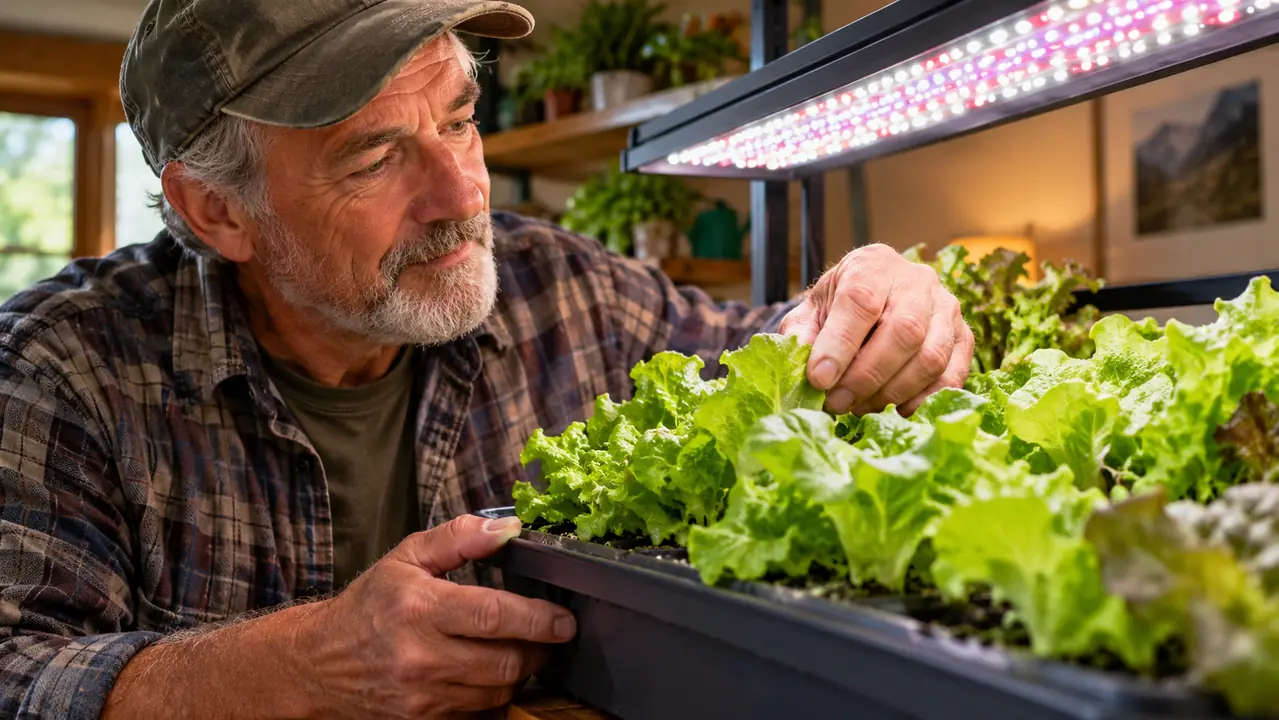
The Mars Hydro TS1000 draws 150 watts from the wall, and that is the real number, not an equivalent or a peak rating. The manual says it replaces a 250 watt HPS bulb, and after growing under both, I believe that. It uses full spectrum LEDs, meaning it includes the red and blue wavelengths plants need along with white light. The result is that leaves look like normal green leaves under it, not the strange purple glow you get from older blurple lights. That matters if you grow in a room you also use for anything else.
The light panel is thin and well built, with a driver that sits separate from the panel and connects by a cable. That separate driver is a design choice I appreciate, because it means the heat from the driver is not sitting directly on top of the plants. It also means you have a small metal box to mount somewhere. I screwed mine to the underside of my table and forgot about it. The cable is long enough that you can place the driver a few feet away if you want.
The dimmer knob is on the driver, and it is more useful than I expected. When I start seedlings, I run the light at about 50 percent for the first week. Once the second set of true leaves appears, I turn it up to full. The dial is not marked in precise percentages, so I use a light meter and my notebook, which is how I do everything anyway. Being able to cut the output in half without moving the light up or down is a genuine advantage for someone who starts seeds and grows greens in the same space.
One detail worth knowing: the TS1000 is a single unit, not a daisy chain design. If you want to run two of them, you plug each one into its own outlet. That is fine for most home setups, but it means a small power strip is part of the shopping list. I use a six outlet strip with a mechanical timer, and it handles everything without complaint.
Eight months in, not a single diode has failed, and my notes show the same tray produced lettuce from October to May.
What Nobody Tells You Before You Buy
The product page makes the light look like a perfect rectangle of brightness over your whole table. The truth is more honest and more interesting. At 18 inches above the canopy, the usable coverage is about 2 feet by 2 feet for leafy greens. The light does spill beyond that, but the edges are noticeably dimmer, and plants at the corners grow slower. If you want to cover a 4 foot table, you need two of these or one bigger unit. I wish more reviews said that plainly.
Heat is the thing nobody talks about. The light panel itself does not get dangerously hot, but it does put out warmth, and in an upstairs room in a North Carolina summer, that warmth matters. I measured the temperature at the canopy rising about 4 degrees when the light was on. In winter that is a bonus. In July I had to run a small fan and move my grow start time to early morning. Plan for it if your grow room is small and upstairs like mine.
The driver makes a faint hum. It is not loud enough to hear across the room, but if you are the kind of person who notices a refrigerator compressor, you will notice this one. I put the driver on a piece of foam rubber and the hum dropped to almost nothing. That is a five minute fix, and it is worth doing.
Two smaller things are worth knowing. The small clips that hold the hanging wires to the panel are plastic. They work, and I have not had one break in eight months, but I check them when I adjust the timer. And there is no power switch on the light itself. You turn it on and off with whatever timer or outlet you plug into. That is normal for grow lights in this class, but if you are used to a simple lamp with a switch, it takes a week to get used to.
What I Liked
- Full spectrum light that makes leaves look like normal green leaves
- Real 150 watt draw with output that matches the manual
- Separate driver keeps heat away from the canopy
- Quiet enough to run in a bedroom without disturbing anyone
- Dimmer is genuinely useful for seedlings and young plants
- Eight months of daily use with no failures
Where It Falls Short
- Usable coverage is about 2 by 2 feet, not the whole table
- Adds noticeable heat in a small upstairs room in summer
- No built in timer, so you need to buy one separately
- Plastic clips on the hanging wires feel lighter than the rest of the build
How It Has Held Up Over Eight Months
I am a retired HVAC technician, which means I have strong opinions about things that hum, things that get warm, and things that should last. The TS1000 has held up better than I expected. I vacuum the fins on the driver every few weeks, wipe the light panel with a dry microfiber cloth when dust builds up, and that is the whole maintenance routine. No dead diodes, no flicker, no change in brightness that I can measure with my light meter.
The proof is in my grow log. I planted a fresh round of lettuce every three weeks, and the germination and growth rate stayed consistent from October to May. The light did not fade, and neither did my interest. I have bought cheap lights before that I replaced within a year. I do not expect to replace this one on any schedule I can plan for.
The only thing I have replaced in that time is the mechanical timer, and that was a timer I already owned, not part of the light. The Mars Hydro unit itself has been maintenance free. For someone who grew up fixing furnaces and checking capacitors, that is the highest compliment I can offer a piece of electrical equipment.
What the Numbers Say at the Canopy
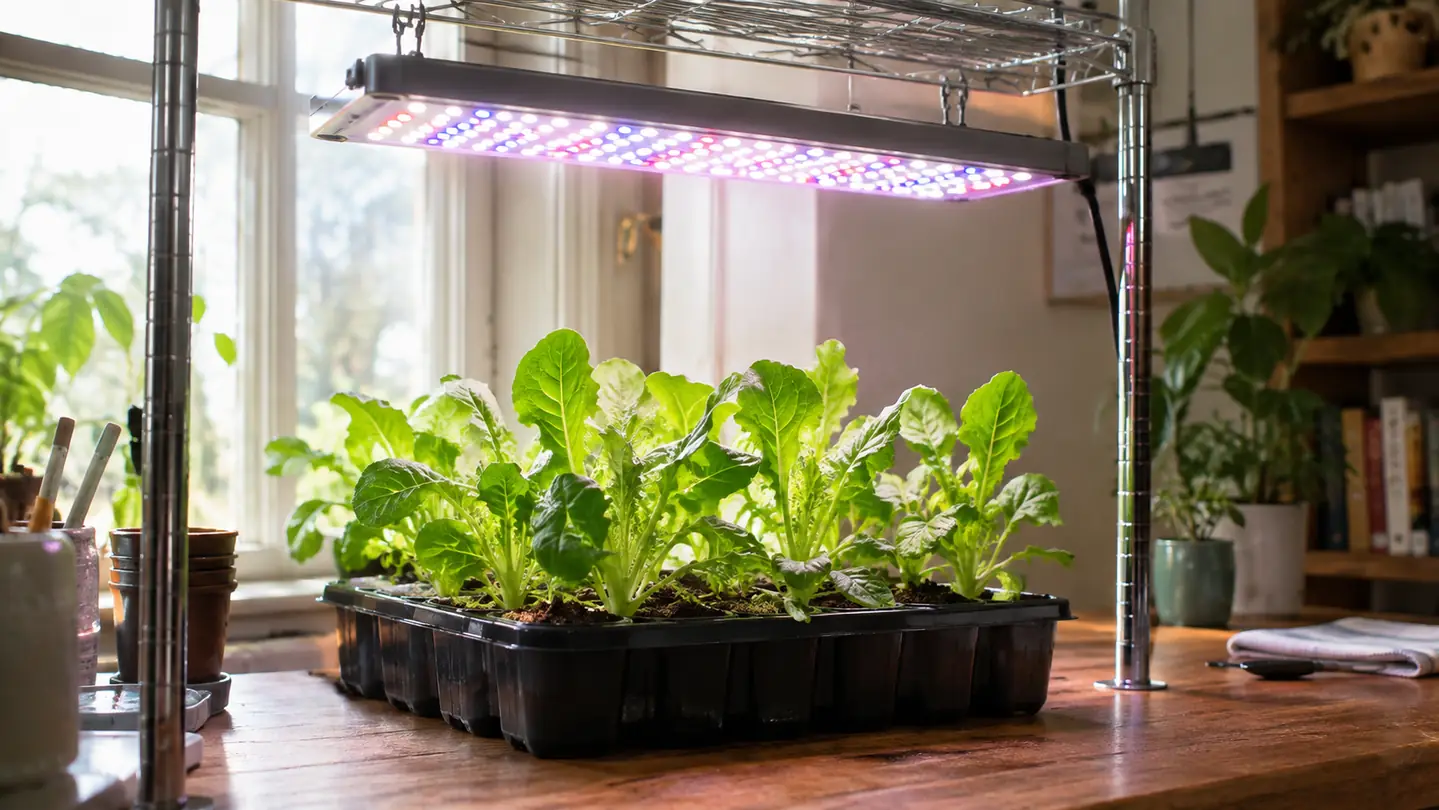
Because I measure everything, I took readings at the canopy with a cheap light meter before I bought the TS1000 and again after I hung it. The numbers confirmed what the manual claims. At 18 inches, the center of the tray reads a solid level for leafy greens, and the corners read about 20 percent lower. That is why I keep my tray smaller than the light's maximum footprint. The plants in the middle and the plants at the edges grow at the same rate, and my harvest is consistent row after row.
I also checked the light at 12 inches and at 24 inches. At 12 inches the center reading goes up noticeably, but the usable area gets smaller, and I started to see slight leaf curl on the lettuce, which is a sign of too much light for that plant. At 24 inches the coverage widens but the center reading drops, and the lettuce got a little leggy. Eighteen inches is the sweet spot for my setup. Your distance may differ, which is why a light meter and a notebook are worth the trouble.
One more measurement note. The full spectrum white light makes it easy to spot problems. Under the old blurple lights I could not tell if a leaf was pale because it needed nitrogen or because the light made everything look strange. Under the TS1000, the plants look like plants, and the leaves show their true color. That alone saved me from at least one overfeeding mistake this winter.
I also measured the power draw, because I am the kind of person who does that. At full output the light draws 150 watts, and at the half setting it draws about 80 watts. Over a 14 hour day, that is a modest load. My electric bill went up by an amount I noticed but did not dread, and Linda has never complained, which is my standard for acceptable.
Alternatives I Considered
Before I settled on the Mars Hydro TS1000, I looked at cheaper blurple lights, the ones that make everything look purple, and at bigger panels that would cover more area. The blurple lights were tempting on price, but I could not get past the color, and the few I tried did not grow lettuce as well. The bigger panels covered more table, but they cost more and threw more heat, and for one 2 by 2 tray they were overkill.
I also considered two smaller lights instead of one 150 watt unit. That would have let me spread the coverage over a longer table. In the end I chose the single TS1000 because my table is square, because one driver is simpler to mount, and because the reviews from other home growers matched what I wanted. I do not regret the choice, but if my table were longer than it is wide, I would have gone with two smaller lights.
I have not tried every grow light on the market, and I am not going to pretend otherwise. What I can tell you is that the TS1000 sits in a practical middle ground. It is not the cheapest light you can buy, and it is not the most powerful. It is the light that does the job without drama, and after eight months, that is exactly what I wanted.
Who This Is For
This light is for the home grower with one small area and a desire for reliable, no drama results. If you grow herbs on a shelf, lettuce in a tray, or seedlings for a spring garden, the Mars Hydro TS1000 is sized right for that job. It is also for people who like to measure and adjust, because the dimmer gives you real control, and for anyone who wants a light that does not sound like a jet engine in the living space. If you are willing to keep a small fan handy and learn the coverage limits, it will treat you well.
It is also a good first grow light for someone coming from a sunny windowsill. The learning curve is gentle. Hang it at the recommended distance, set a timer, and start with something forgiving like lettuce or basil. My experience is that the light rewards consistency more than any particular skill.
Who Should Skip It
Skip it if you are trying to cover a long table or a whole room, because you will need multiple units and the cost and heat add up. Skip it if your grow space is already warm and you have no way to move air, because the heat is real. Skip it if you want a plug and play light with a built in timer, because you will have to buy a timer separately. And if you are growing plants that need intense light, like fruiting tomatoes or peppers, one TS1000 will be marginal. You would want more wattage or a second light, and that is not the light's fault. It is just physics.
I will also say this. If you are the kind of grower who wants to set a light and forget it, with no interest in measuring or adjusting, a cheaper fixed output light may serve you just as well. The TS1000 rewards people who use the dimmer and check their plants. That is not a flaw. It is just a fact about the product.
Still on the fence? Here is my honest bottom line.
Eight months in, the Mars Hydro TS1000 is the light I would buy again for a small grow area. It has limits, and now you know exactly what they are. Check today's price on Amazon and decide for yourself.
Amazon Check Today's Price on Amazon →