

The first time I checked the pH in my aeroponic reservoir, the test liquid turned a color that was nowhere near the chart. I remember the date because I wrote it in my grow log: March 14, three weeks into my first indoor lettuce crop, growing in a spare bedroom upstairs, and the new leaves had gone pale. The plants were not sick. The pH was wrong. In an aeroponic system the roots hang in the air and get misted every few minutes, so there is no soil to buffer anything. Every mistake shows up fast, and this one showed up in the leaves before I knew what to look for. The General Hydroponics pH Control Kit had been sitting on my shelf for a month, and it was the tool that finally made the problem visible. Keeping the reservoir between 5.5 and 6.5 is the single most useful thing I have learned in four years of growing indoors, and it took one failed crop to figure it out.
This is not complicated, but it is precise, and precision is the part of the job I understand from thirty years of HVAC work. You measure, you adjust, you wait, you measure again. The tools are cheap and the whole routine takes about five minutes a day once it becomes a habit. I use the General Hydroponics pH Control Kit, which comes with a liquid test indicator, pH Up, and pH Down in one box. The steps below are exactly what I do in my own grow room, including the parts I got wrong the first time so you do not have to repeat them.
The Kit That Makes the Routine Painless
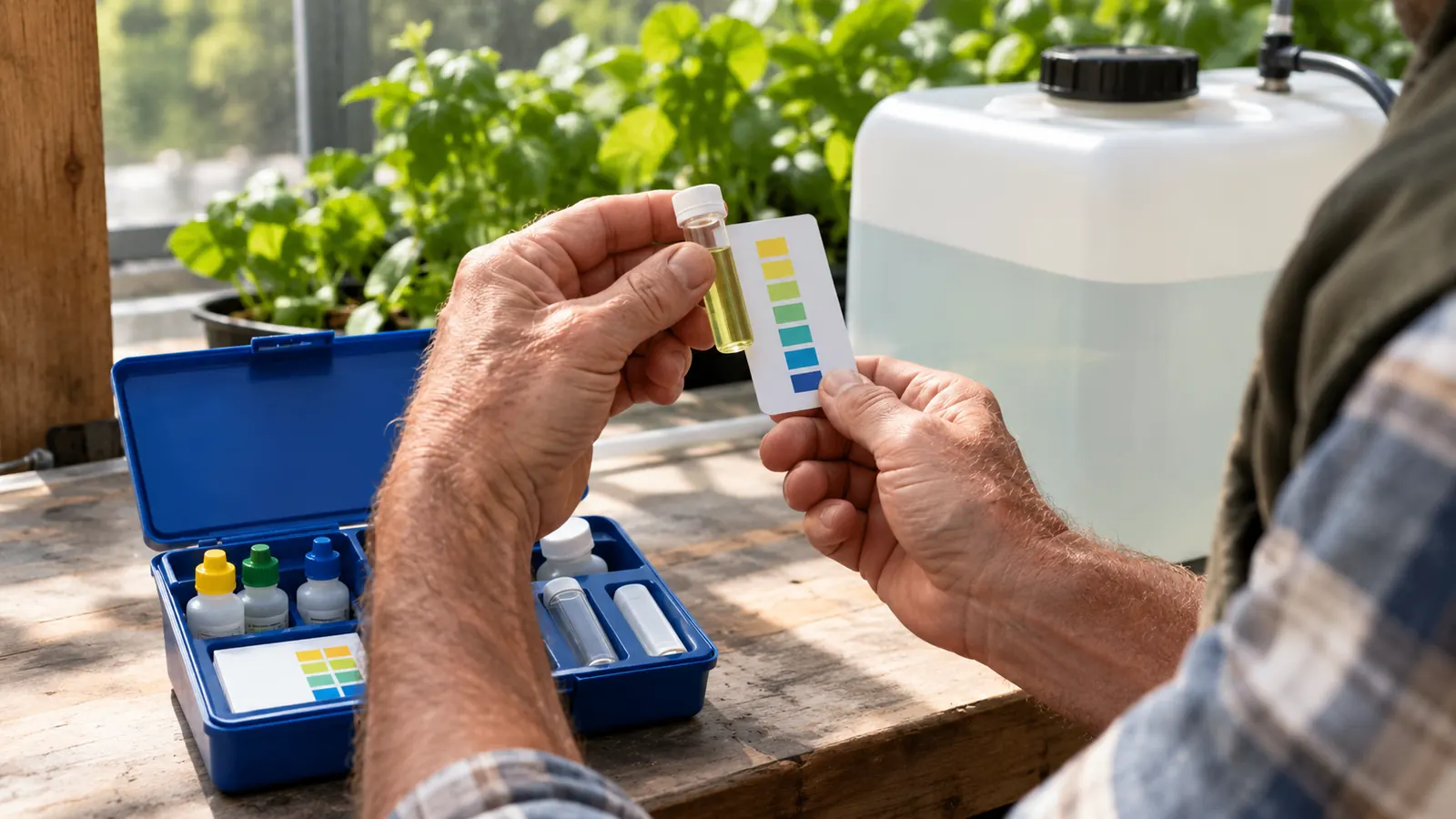
The General Hydroponics pH Control Kit has the test indicator, pH Up, and pH Down in one box. No separate bottles to hunt down, and the same kit has lasted me two seasons.
Amazon Check Today's Price on Amazon →Step 1: Test the Source Water Before You Mix Anything
My tap water here in Raleigh runs between 7.4 and 7.9 depending on the season, and it comes out of the faucet full of chlorine. I keep two gallon jugs on the counter and fill them a day ahead, so the water sits overnight before it goes anywhere near the plants. That one habit got rid of more early problems than anything else I changed, because chlorine and the other additives push the reading around and make the test meaningless. Test the plain water the same way you will test the reservoir, with the same dropper and the same vial.
The first time I skipped this, I filled the reservoir straight from the tap, added nutrients, and put in the seedlings. Three weeks later the leaves were pale and the roots looked thin. When I finally tested the water, it read 7.9, and I wrote 'pH 7.9, leaves pale, roots thin' in the log with a question mark next to it. At that pH the plants cannot take up iron, so they looked like they had a deficiency when the real problem was the starting water. The plants were not sick. The pH was wrong.
So the routine starts before the reservoir is even full. Fill the jugs, let them sit, then test the plain water and write the number in the log. If your tap water reads above 7.5, you will be using pH Down a lot. If it reads below 6.5, you will be using pH Up. Knowing that before you plant saves a lot of guessing later, and it also tells you how much of each bottle to keep on hand. I bought a second bottle of pH Down after my first summer because the tap water ran high and I went through the little bottle twice as fast.
Step 2: Add Nutrients First, Then Adjust the pH
Order matters more than people think. If you adjust the water to 6.0 and then add your nutrient mix, the nutrients will swing the pH again and you will be chasing your tail. The nutrient solution I use is two parts, and each part pulls the pH in a different direction. So the only sane sequence is: fill the reservoir, add both nutrient parts, run the pump for fifteen minutes, and only then test. I also write the starting reading in the log before I touch any bottle, so I can see later how much the nutrients moved it.
I learned this the hard way in my second season. I had adjusted a fresh reservoir down to 6.0, felt proud of myself, and then added the nutrients. When I checked an hour later the reading had dropped to 4.8. The plants sat in that acid water for a full day before I caught it, and the basil never fully forgave me. The leaves curled at the edges and the growth stalled for almost two weeks. It was the kind of mistake that a five minute check would have caught, and I have never made it since. Now the nutrients go in first, every single time, and I do not touch the pH until the pump has had a chance to mix everything.
One note on mixing: aeroponic systems recirculate through the misters, so fifteen minutes of pump time is enough to blend a four or five gallon reservoir completely. I set a timer on my phone, not a guess. While it runs I clean the test vial from the day before, because leftover indicator in the glass will throw off the next reading. A dirty vial is the kind of small thing that makes you chase a problem that is not there.
Step 3: Adjust in Small Drops, Then Wait
pH Up and pH Down are concentrated, and a small reservoir has no room for mistakes. Mine holds about four gallons of mixed nutrient solution. The first time I used pH Down, I added a full capful because that is what the bottle said for a larger tank. The reading went from 6.8 to 4.2 in one afternoon. I spent the next two days nudging it back up a few drops at a time while the plants sulked. That was the day I learned to read the label as a starting point, not a rule.
Now I start with a quarter of what I think I need. For my four gallon reservoir, that means about five drops of pH Down to move the reading a few tenths. I add them, run the pump for ten minutes, and test again. If it is still high, I repeat. It is boring, and boring is exactly what you want. The plants do not need the pH to be perfect, they need it to be stable, and stable comes from small corrections made slowly, not one big correction made fast.
Give the water time to actually mix before you trust the retest. In an aeroponic system the pump sprays the roots on a cycle, but the reservoir itself only gets fully blended after the pump has run for a while. Ten to fifteen minutes is enough at my scale. If I test too soon, I read the water near the top, where the fresh drops are still sitting, and I overshoot. Then I have to correct the correction, which is how you end up with a reservoir that never settles down.

Step 4: Check Daily and Write It Down
The pH in a working aeroponic reservoir does not sit still. As the plants drink, the water level drops and the nutrients get more concentrated, and the pH creeps upward. In my upstairs grow room in the winter, when the heat runs and the air is dry, I can lose half a gallon of water a day and the pH can climb a couple of tenths between morning and night. That is normal. What is not normal is a big jump, and the only way to tell the difference is to check every day. The plants will not tell you until it has been wrong for a while.
I have kept a paper grow log since day one, which is a habit I carried over from my HVAC days. Every morning with my coffee I test the reservoir, write the date, the pH, the water temperature, and anything I changed the day before. A typical entry reads '3/12, pH 6.2, temp 68, topped off 200 ml, no adjustment.' The log is how I noticed that my pH always climbs fastest on the third day after a nutrient change, which told me to check more closely that day.
The daily check takes five minutes. Test, write it down, adjust only if the reading is outside 5.5 to 6.5, and walk away. Most days I do not adjust anything. The discipline is in the testing, not in the fiddling. If I had only checked when the plants looked unhappy, I would have missed most of the drift, because by the time the leaves show it, the pH has been off for days and the damage is already started.
Step 5: Top Off First, Then Flush on a Schedule
When the reservoir gets low, I top it off with plain water that has been sitting out, and I always test after the top-off, not before. Plain water dilutes the nutrient mix and changes the pH, usually upward. So the order is: top off, run the pump, test, adjust. If I adjusted before topping off, I would be correcting a reading that was about to change anyway, and I would be right back at the reservoir an hour later.
Every other Sunday I do a full reservoir change. I empty the tank, wipe down the inside with a clean cloth, rinse the misters, and refill with fresh nutrient mix. The whole job takes about thirty minutes. I mark it in the log with a circle around the date so I can see at a glance that it got done. A schedule is better than a memory, because a busy week will eat a memory, and the reservoir does not care how busy you were.
I skipped the flush once, in my first year, because the plants looked fine and I was busy. Three weeks in, the pH swung from 6.0 to 7.6 in three days and the basil went yellow almost overnight. What had happened was a build-up of salts in the reservoir, and it pushed the pH around no matter what I did. A flush and a fresh mix fixed it within a week. Now the flush is on the calendar, not on how the plants look, and I have not had a swing like that since. The phone reminder goes off Sunday morning, and the log gets its circle.
What Else Helps
A few small things make the routine easier. Keep the reservoir out of direct light, because light grows algae and algae swings the pH at night. My tank sits under the grow table, which is dark enough that I have not had an algae problem since I moved it there. Wash the test vial after every use and let it dry upside down. A film of old indicator will change the next reading, and you will spend a day chasing a number that was never real.
The liquid indicator in the General kit is easier for me to read than test strips. I am sixty-one, and my eyes are not what they were. The color chart that comes with the kit is big enough that I can hold the vial next to it in good light and read the result without squinting. Test strips work fine for some people, but I have never gotten a clear answer from a strip, so I stick with the drops. If you wear reading glasses, keep them on the table next to the kit.
If you move your system out to a covered porch in the warmer months like I do, expect the pH to drift faster. Warm water holds less dissolved oxygen and the plants drink more, so the reservoir swings more between checks. The answer is not a bigger adjustment, it is a more frequent check. On hot weeks I test twice a day and the log gets a second column. The routine does not change, it just happens more often.
One capful of pH Down took my reservoir from 6.8 to 4.2 in a single afternoon. Now I add drops, not capfuls, and I wait.
Start With the Kit That Has the Whole Routine in One Box
The General Hydroponics pH Control Kit is the same one sitting on my bench right now. Test indicator, pH Up, and pH Down, and the only other thing you need is a notebook. Five minutes a day beats a failed crop every time.
Amazon Check Today's Price on Amazon →