
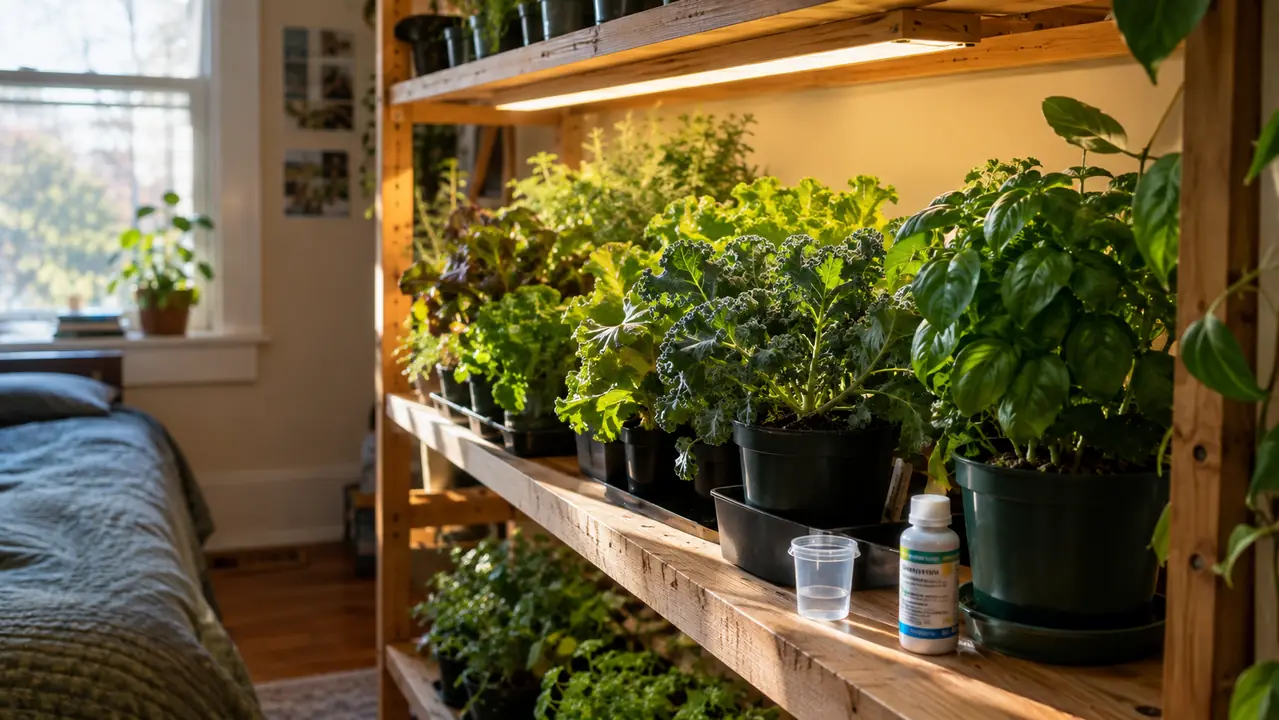
Four years ago, when I turned the spare bedroom upstairs into a grow room, I figured the nutrients were the whole ball game. Mix them right and the lettuce grows. Mix them wrong and it does not. It took me about three weeks and one very sad batch of basil to learn that pH is the thing that actually bites you. The nutrient mix can be perfect and the plants still turn pale if the water is sitting at 7.8. That is why I bought the General Hydroponics pH Control Kit, and that is why the same three bottles are still on my shelf a year later.
Before I go any further, here is what this review is and is not. It is not the product page with different words. It is what I learned testing every batch of city tap water I have mixed in the last year, written down in the paper grow log I have kept since day one. It is also the stuff I wish somebody had told me before I opened the box, because a few of those things would have saved me a stained dish towel and a little frustration.
The Quick Verdict
A simple, dependable kit that does the one job a home grower needs done, once you accept that reading colors by eye is a skill you have to practice.
Amazon Check Today's Price →Tired of guessing whether your pH is right?
If you are mixing your own nutrients and you do not have a reliable way to check the pH, this is the kit I reach for every time I mix a batch. No batteries, no calibration, just a clear reading you can act on.
Amazon Check Today's Price on Amazon →How I've Used It
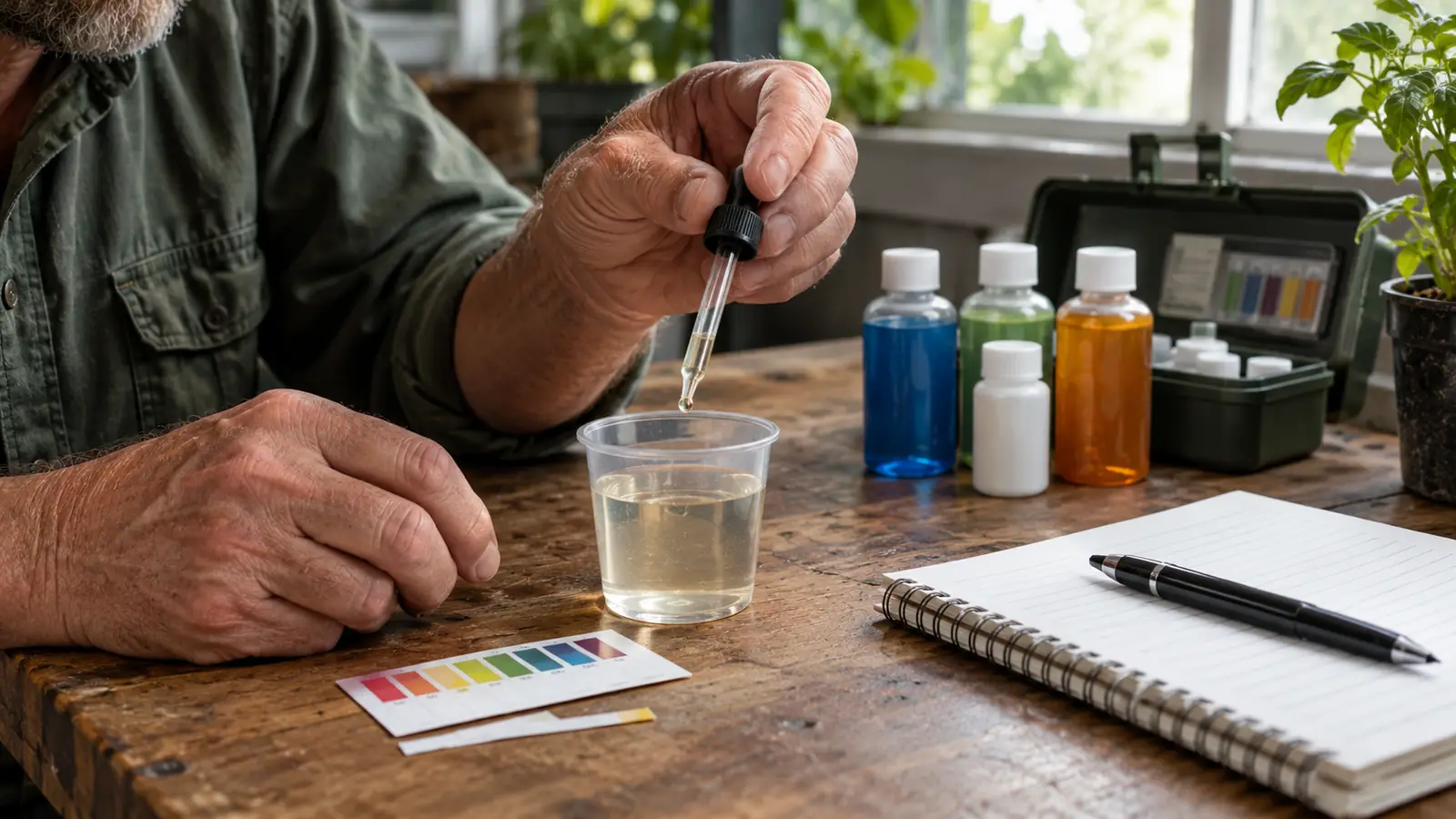
My routine is boring on purpose. I fill a five gallon bucket with city tap water and let it sit overnight so the chlorine can work its way out. In the morning I add the nutrients, stir, and test the pH before anything goes near the plants. I take a small sample of water in the little cup that came with the General Hydroponics kit, add three drops of the test indicator, and hold the cup up against the color chart printed on the bottle.
If the color says I am too high, which is almost always the case with my tap water, I add pH Down a quarter dropper at a time, stir, and test again. The first time I did this I dumped in a full dropper and overshot all the way to the other side, which taught me the first honest lesson of this kit. It is not the product that overshoots. It is the user. A quarter dropper, a stir, a re-test. That rhythm has never failed me since.
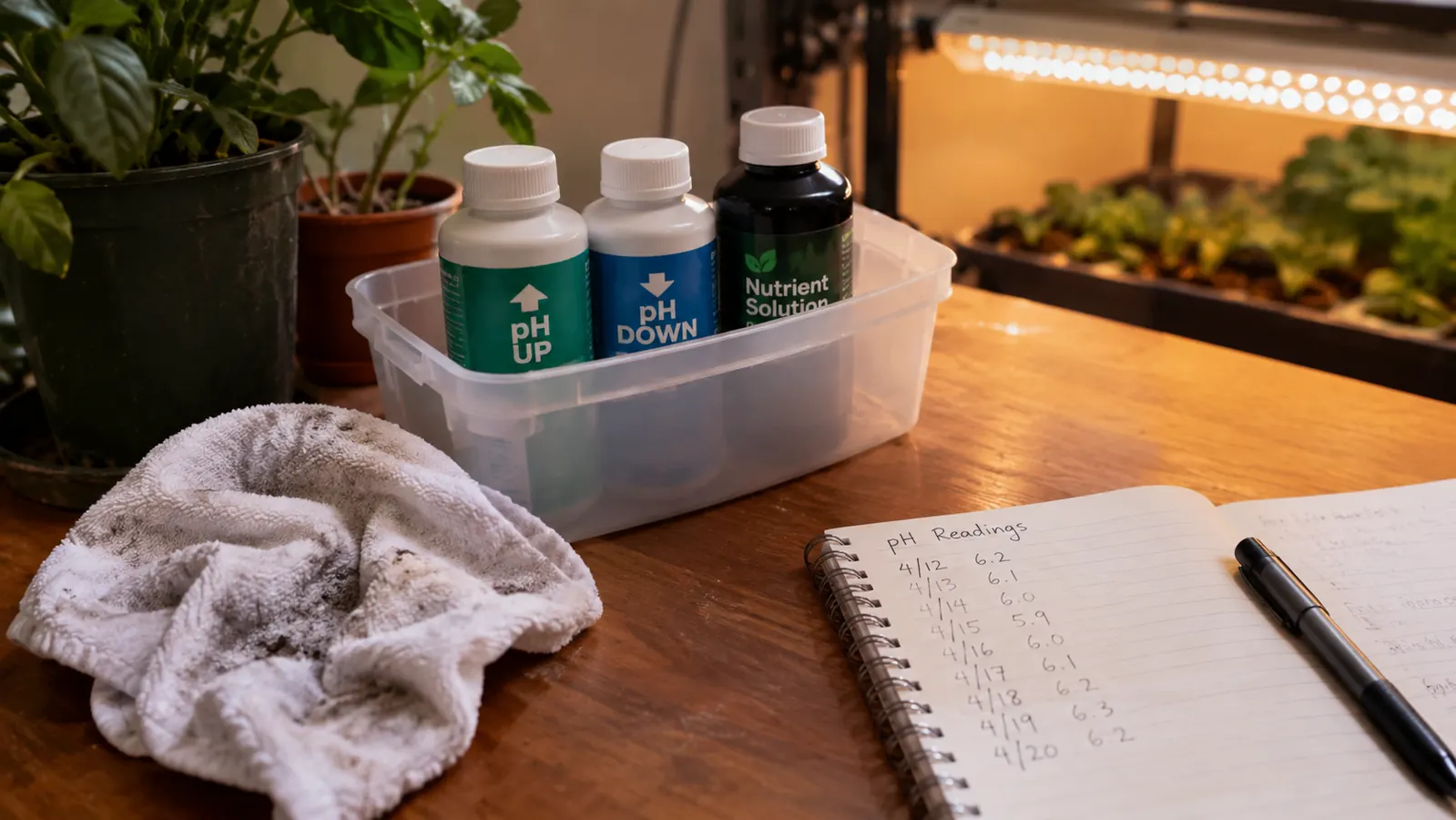
I write every reading in my paper grow log. Date, time, pH before, pH after, and how much Up or Down it took to get there. After a year of that, I can tell you my tap water runs high, my nutrient mix pulls it down a little, and the whole system drifts upward over the week between changes. You cannot see any of that without a log, and none of it is the kind of thing the product page mentions.
What the Kit Actually Includes (and What It Doesn't)
The box holds three bottles and a small measuring cup. There is the pH Up, which is potassium hydroxide, the pH Down, which is phosphoric acid, and the test indicator, which is the little dropper bottle you use to read where you are. That is the whole kit. There is no digital meter, no calibration fluid, no fancy case, and no chart glued inside the lid. You compare the color of your sample to the printed chart on the side of the indicator bottle.
For a home grower, that is mostly fine. The kit is simple on purpose, and simple is what most of us need. But let me be straight about what you are not getting. You are not getting a precise number. You are getting a color, and the color tells you a range. For lettuce, basil, and leafy greens, a range is plenty. If you ever move to crops that demand a very tight window, you will probably want a digital meter working alongside this kit, not instead of it.
The other thing the box does not tell you is that the indicator stains. It is a dye, it is doing its job, and it will leave a pink mark on anything porous it touches. I learned this on a white dish towel, and Linda still brings it up. Keep an old rag in the grow room and you will never have to have that argument.
The first few weeks were not smooth. My tap water reads high, so I was always adding pH Down, and I overshot enough times that Linda suggested I keep a notebook just for the mistakes. That notebook became the grow log, and the mistakes stopped repeating once I could see them written down. If you are new to this, expect the first batch or two to be ugly. It gets better fast.
The Drops Test: The Part Nobody Warns You About
Reading the color is the weak point of the whole system, and it is not the kit's fault. The chart runs from yellow through green to blue, and telling the difference between a 6.0 green and a 6.5 green under a grow light at night is genuinely hard. Some evenings I carried the cup to the window to check it in daylight. That is not a product flaw. It is the nature of testing color by eye, and it is the reason so many people eventually move to a digital meter.
You can make it easier on yourself in three small ways. Use a clear glass or the white cup, hold it against something white, and test in the same spot every time so your eyes get a consistent background. I test on the white lid of my toolbox, under the same light, at the same time of day. Once I standardized that, my readings stopped jumping around, and my plants stopped looking confused.
The other honest limitation is that the indicator runs out faster than the Up and Down. You use a few drops every time you test, several times a week, so the little bottle empties first. That is not a con so much as a planning note. I buy a spare bottle of indicator at the same time I reorder nutrients, and I have never been caught short.
What Nobody Tells You About the Up and Down Bottles
These two bottles do the hard work, and they deserve respect. The pH Down is phosphoric acid. It will eat through a cotton shirt, and it will sting if it splashes on your skin. My first bottle arrived with a slightly cracked cap and leaked a little in the box, which is a gripe you will see repeated in the reviews if you look for it. The liquid stained the cardboard and nothing else, but I moved both bottles into a small plastic tote the same day and never looked back.
The other thing the label does not emphasize is concentration. A little goes a long way. My five gallon batches take maybe a quarter dropper of pH Down to move half a point, and the same tiny amount of pH Up when I overshoot. The two bottles have lasted me more than a year. Treat them like medicine rather than like a cleaning product, and they behave exactly as advertised.
Wear an old shirt, keep a rag nearby, and add the stuff in small amounts with a stir between each addition. That is the whole technique. There is no mystery to it, and that is the point. The kit does not need skill to work. It needs patience, and patience is free.
How the Kit Holds Up After a Year
After a year of steady use, the bottles still read the same and the chart has not faded. The dropper caps are the part to watch. The little rubber bulbs eventually get stiff, and I replaced the cap on the Up bottle once when it started to drip. The bottle itself is fine, and the solution inside is fine. It is the cheap part of the design that wears first, and a replacement cap costs next to nothing.
The test indicator has a long shelf life, and I have never had a bottle go bad. I keep all three bottles in the same tote, out of the light, with the date I opened each one written on the lid in marker. That habit came from my HVAC days, when we dated every part we installed. It has saved me more than once from using a bottle I could not remember opening.
One more thing worth saying, because it is the review nobody writes. The kit is forgiving. If you overshoot, the pH Up fixes it. If the color is confusing, test again. If you spill, it cleans up. The only way to get in real trouble is to skip testing altogether, and no bottle of anything can help you then.
The Digital Meter Question
I know this review is supposed to be about the kit, but the honest version has to talk about the meter, because that is the fork in the road every home grower reaches. I have used both. I borrowed a digital meter for a season to check my drops readings against it, and the two agreed closely enough that I stopped worrying. For the crops I grow, the color test was never the weak link in my system. The weak link was me skipping a test when I was tired.
Where the meter wins is speed and precision. It gives you a number in seconds, and it removes the eyesight question entirely. Where the kit wins is simplicity and cost. There are no batteries to die, no probe to store wet, no calibration solution to buy, and nothing to drift out of spec in a drawer between grows. For a home grower with a handful of plants, that trade is hard to beat.
One warning about the meter path, since nobody gives it either. A cheap meter can be worse than the drops kit, because it drifts and needs calibration, and if you do not calibrate it, it gives you a confident wrong number. I would rather trust a color I can see with my own eyes than a number from a probe I have not checked in months. If you buy a meter, buy a decent one and learn to calibrate it.
My honest advice is the same thing I would tell a neighbor over the fence. Start with the drops kit. Learn what your tap water does, learn how your nutrients move it, and keep the paper log. If you find yourself squinting at colors more than once a week, buy a digital meter then. You will understand what the meter is telling you, because you already learned it the slow way.
What I Liked
- No batteries, no calibration, no settings. It just works.
- The Up and Down bottles last a year or more at home grower doses.
- Accurate enough for lettuce, basil, herbs, and most home crops.
- Simple enough for a beginner to learn in one weekend.
- Comes complete with the measuring cup and the printed color chart.
Where It Falls Short
- Reading the color by eye is the weak link, especially under grow lights.
- The indicator stains anything porous it touches.
- The dropper caps are the first part to wear out.
- No storage case, and the bottles can leak in shipping.
- If you need a precise number, you will want a digital meter alongside it.
In a year of mixing every batch with this kit, I have never had a reading I could not reproduce the next day. That is the whole test of a pH kit.
Who This Is For
This kit is for the home grower who wants to keep things simple and is willing to build a small routine. If you grow lettuce, basil, or leafy greens in a spare room, and you are happy to test by color every time you mix a batch, this is a solid, honest tool. It is also for the beginner who is not sure how deep they want to go. Start here, learn the rhythm, and upgrade later if you outgrow it.
It is also for people like me who like a physical record. A paper log and a color chart are slower than a digital readout, but they are harder to ignore. You see the color, you write down the number, you notice the drift week to week. There is something to be said for a method that makes you slow down and look at what you are doing.
Who Should Skip It
Skip this kit if you want a precise pH number, or if your eyesight makes fine color work a chore. I am 61, and my close-up vision is not what it used to be. There are evenings I take the sample to the window to be sure of the color, and if that sounds like a frustration you do not need, buy a digital meter instead. This kit is not a substitute for one, and I would rather you buy the right tool than blame this one for a job it was never designed to do.
Also skip it if you are growing something that demands a very tight pH window, or if you simply want to spend less time testing. The drops method takes a few minutes and a steady hand. A meter gives you a number in seconds. Neither is wrong. They are different tools for different temperaments, and an honest review should say so plainly.
And one more group: if you already own a digital meter and it works for you, you do not need this kit. That sounds like a strange thing for a review to say, but it is the honest one. The General Hydroponics pH Control Kit is a great first tool and a dependable backup. It is not a thing you collect. Buy it if you need it, and skip it if you already have a method that is working.
The kit I still reach for after a year of growing
If you are mixing your own nutrients and you do not have a reliable way to check pH, start here. The General Hydroponics pH Control Kit is simple, it works, and it will not end up in a drawer after the first month.
Amazon Check Today's Price on Amazon →